

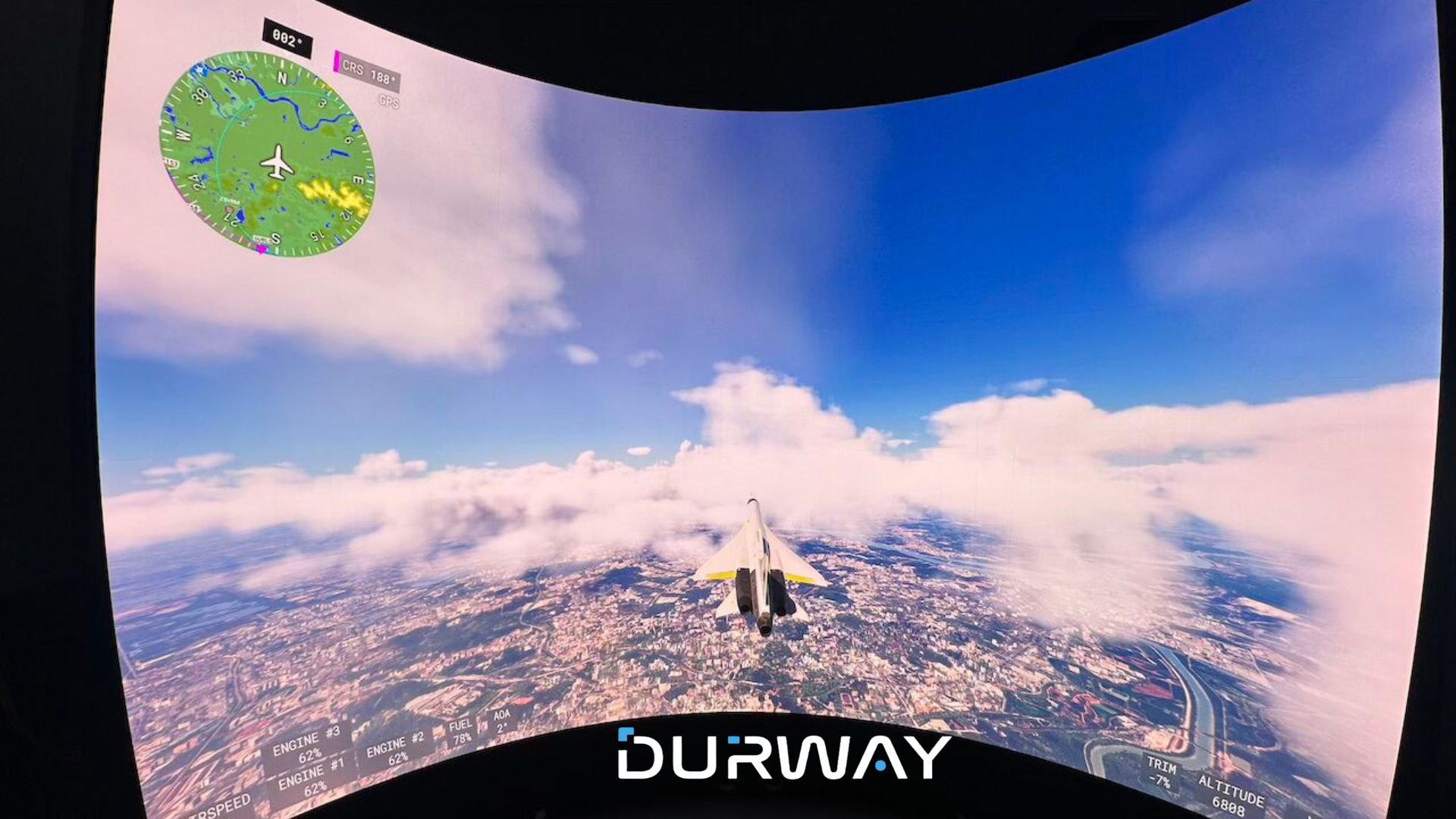
The Future of Civil Aviation Training: Why LED Visual Systems are Transforming Flight Simulation
In the professional flight training industry, the “Visual System” is the most critical link between a pilot’s inputs and their sensory perception. For decades, Flight Training Organizations (FTOs) and commercial simulator manufacturers have relied on projection systems. However, as the demand for higher training fidelity and 24/7 operational availability increases, the limitations of traditional projectors—low contrast, frequent recalibration, and high maintenance costs—have become clear.
Direct View LED (dvLED) technology is now setting a new gold standard. By replacing aging projection setups with very fine-pitch LED simulator displays, flight schools can achieve a level of realism and reliability that was previously impossible.
1. True Color Realism and High-Dynamic Range (HDR)
The sky is rarely a uniform blue. From the hazy orange of a sunset approach to the stark, high-contrast glare of a midday landing in the desert, pilots must be trained to recognize subtle visual cues.
-
Beyond Projection Limits: Projectors often “wash out” colors, making the environment look flat. LED panels, however, produce their own light, allowing for a much wider color gamut.
-
Realistic Environmental Cues: In a Durway-powered LED simulator, the green of a forest, the shimmering reflection of water, or the flashing strobe of a runway light are rendered with lifelike saturation. This helps student pilots better judge altitude and distance during critical phases of flight.
2. Dynamic Brightness: Mastering “Sunlight Readable” Training
One of the biggest flaws of projection-based simulators is their inability to simulate bright daylight. Most projectors struggle to exceed 500-800 nits of brightness on a screen.
-
The LED Advantage: Durway’s simulation-grade LED panels can reach brightness levels of 3500 nits or more.
-
Why it Matters: This allows for realistic “daylight” training where the sun’s glare on the windscreen or the “white-out” effect of flying through clouds is physically accurate. Conversely, these systems can be dimmed with extreme precision for dawn, dusk, or night-time taxiing exercises without losing detail.
3. Seamless Visuals: A Flawless 120° to 360° Field of View
Traditional simulators use multiple projectors that require “edge blending” software to stitch images together. These “seams” are often visible to the pilot, breaking the immersion and reducing the effectiveness of the training.
-
Zero Seams, Zero Distraction: Unlike projection, which is cast onto a surface, LED is the surface. Durway’s modules are engineered to align with sub-millimeter precision.
-
Permanent Alignment: Once an LED wall is installed in a curved or dome configuration, it never “shifts.” You no longer have to worry about vibrating projectors or lens drift that requires daily manual adjustment. The result is a rock-solid, continuous visual horizon.
4. Drastically Lower Total Cost of Ownership (TCO)
For commercial flight schools, “Simulator Downtime” equals lost revenue. The maintenance profile of LED is far superior to projection.
-
Longevity: A typical projector lamp lasts 3,000 to 5,000 hours before it dims or fails. A Durway LED system is rated for 100,000 hours.
-
Modular Maintenance: If a projector fails, the entire simulator is usually grounded until a technician arrives. With LED, the system is modular. If a small section is damaged, a non-technical staff member can swap out a single “hot-swappable” LED module in minutes, keeping the training schedule on track.
-
Energy and Cooling: Modern LED systems are more energy-efficient and generate less ambient heat than large-scale projector arrays, reducing the load on the facility’s HVAC system.
5. Specialized Training: From Commercial Jets to Water Bombers
The versatility of LED makes it ideal for specialized civil aviation missions, such as the CL415 Water Bomber or Search and Rescue (SAR) helicopters.
-
High Contrast for Low-Altitude Missions: Pilots flying firefighting missions need to see the contrast between smoke, fire, and terrain clearly. LED’s superior contrast ratio (achieving “True Black” by turning pixels completely off) provides the visual depth needed for dangerous, low-altitude maneuvering.
-
Rapid Refresh Rates: Our panels feature ultra-high refresh rates, ensuring that during fast-paced maneuvers—like banking over a lake to scoop water—there is zero motion blur or image tearing.
Why Choose Durway for Your Simulator Visual Upgrade?
Transitioning to LED is a long-term investment in training quality. At Durway, we provide more than just screens; we provide the engineering backbone for advanced simulation.
-
US-Based Support : Located in El Monte, California, we maintain a local inventory of components. If you need a part, it’s a domestic shipment away, not weeks of international freight.
-
Fine-Pitch Expertise: We specialize in the small pixel pitches (P0.8mm) required for the short viewing distances inside a cockpit simulator.
-
Custom Integration: Our team understands the mechanical requirements of mounting LED systems into the tight, curved radii of flight simulator domes.
Conclusion: Elevate Your Training Standards
The goal of flight simulation is to make the pilot forget they are in a box on the ground. By delivering deeper blacks, brighter suns, and a seamless visual field, LED technology removes the “virtual” from virtual reality.
Invest in a visual system that lasts longer, performs better, and provides your pilots with the most realistic training environment available today.
Contact Durway Today for a LED Simulation Solutions Drezinex
