A round LED screen is a circular LED display that shows content across a full 360-degree viewing field, so visitors can read it from any direction. Durway’s Panora round LED screen comes in four diameters — 480, 960, 1440 and 1920 mm — all with a 2.5 mm pixel pitch, a frameless circular design and front maintenance. For retail and exhibition spaces, the right size depends on viewing distance and ceiling height.
What Is a Round LED Screen?
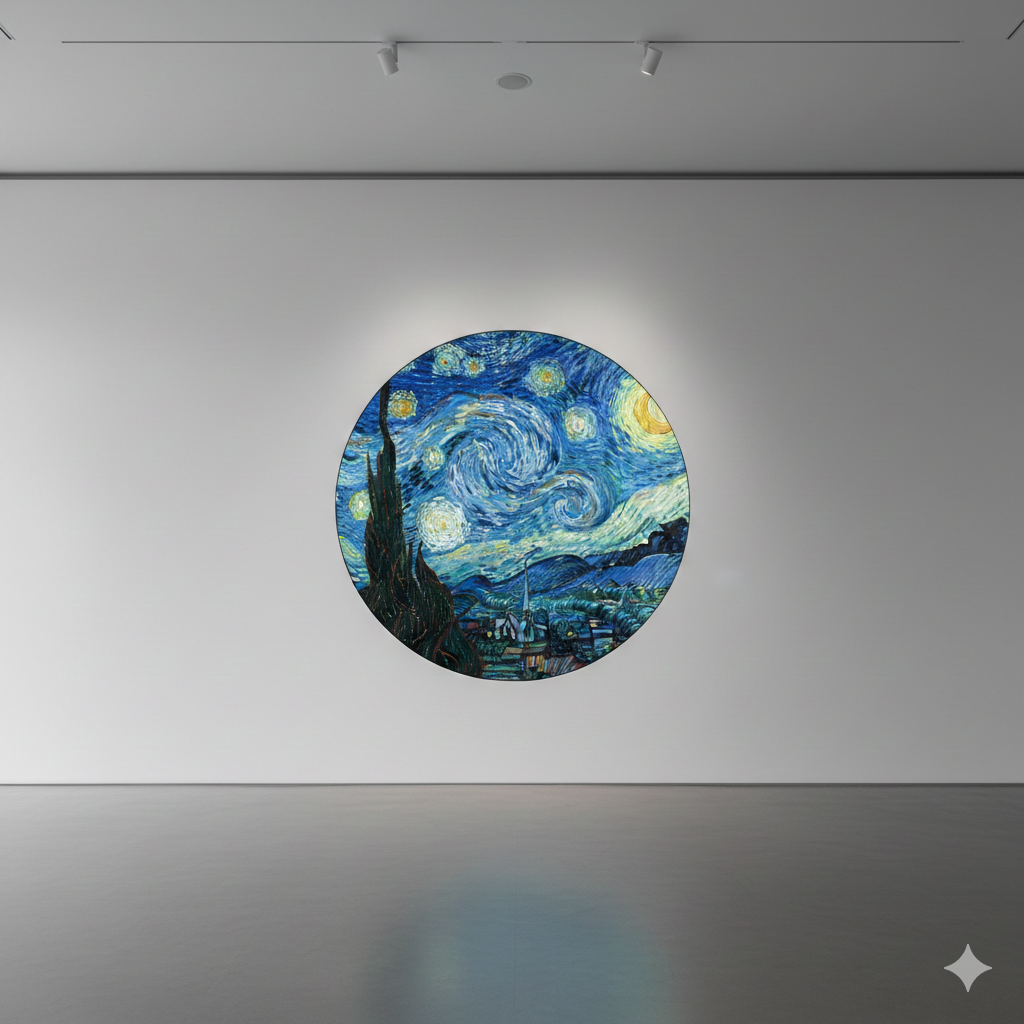
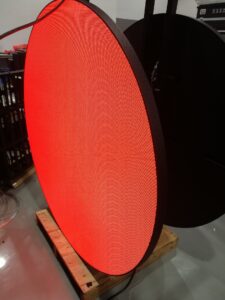
A round LED screen is an LED display built in a circular shape rather than a rectangle. Instead of a flat panel mounted on a wall, the screen forms a disc that can hang from a ceiling, stand on a structure or sit within a larger installation. Because the display surface curves around a full circle, content remains visible from every side.
The most useful way to think about a round LED screen is as a piece of architecture that also happens to be a display. A rectangular screen has a front and a back, and it assumes the audience stands in front of it. A circular screen has no front or back: visitors encounter it from wherever they happen to be.
Durway’s Panora round LED screen is a circular, 360-degree full-view LED display designed for exactly these settings — commercial, retail, exhibition and architectural environments. Its seamless, frameless circular design means there is no visible border breaking the image, and wide-angle calibration keeps colour and brightness consistent from every viewing position, with no colour shift or distortion as the viewer moves around the disc.

How Does a Round LED Screen Work?
A round LED screen works the same way any LED display works: thousands of individual light-emitting diodes form the pixels of the image, and a control system tells each one what colour and brightness to show. The difference is in the geometry: the LED modules are arranged in a circular layout, so the content wraps around the full 360 degrees.
The Panora uses SMD1010 Black pixels with a pixel pitch of 2.5 mm across all four models. Pixel pitch is the distance between the centres of neighbouring pixels, and it is the single most important number for image sharpness: a smaller pitch means more pixels in the same area and a finer image at close range. Because the pitch is the same on every Panora size, image quality is consistent whichever diameter you choose — the decision is about scale, not about sharpness.
The screen surface uses GOB (glue-on-board) technology, a protective coating applied over the LED modules. GOB makes the surface more resistant to knocks, dust and moisture than an unprotected LED face. The surface treatment is waterproof, dustproof and moisture-proof, so the screen is built for real-world commercial use.
The viewing angle is 160 degrees both horizontally and vertically, and the best viewing distance is 7.62 metres. The contrast ratio is 5000:1, and the colour gamut is greater than normal screen, a wide colour standard used in professional video and photography.
What Sizes Are Available, and How Do They Compare?
The Panora round LED screen comes in four diameters: 480 mm, 960 mm, 1440 mm and 1920 mm. Every model shares the same core specification — 2.5 mm pixel pitch, SMD1010 Black pixels, GOB surface, 600-800 nits brightness, 160-degree viewing angle and 5000:1 contrast — so the choice between them is driven by the space, not by a trade-off in quality.
| Feature | Panora 480 | Panora 960 | Panora 1440 | Panora 1920 |
|---|---|---|---|---|
| Diameter | 480 mm | 960 mm | 1440 mm | 1920 mm |
| Pixel pitch | 2.5 mm | 2.5 mm | 2.5 mm | 2.5 mm |
| Pixel type | SMD1010 Black | SMD1010 Black | SMD1010 Black | SMD1010 Black |
| Surface | GOB | GOB | GOB | GOB |
| Brightness | 600–800 nits | 600–800 nits | 600–800 nits | 600–800 nits |
| Viewing angle | 160° H / 160° V | 160° H / 160° V | 160° H / 160° V | 160° H / 160° V |
| Best viewing distance | 7.62 m | 7.62 m | 7.62 m | 7.62 m |
| Contrast | 5000:1 | 5000:1 | 5000:1 | 5000:1 |
| Maintenance | Front | Front | Front | Front |
The smallest model, at 480 mm, is roughly the size of a large wall clock. It works as an accent piece: a brand mark, a small promotional loop above a counter, or a decorative element in a boutique. The 960 mm model is close to a metre across and is a comfortable size for a single shopfront window, a reception area or a modest exhibition stand.
The 1440 mm model is a visual anchor for a retail atrium or a mid-sized exhibition space. The largest model, at 1920 mm — nearly two metres across — is a statement piece for a flagship store, a large trade show pavilion or a museum entrance hall.
Because all four models share the same pixel pitch, a larger screen simply shows more of the image at the same sharpness. There is no penalty for going bigger, and no advantage in image quality for going smaller. The right choice is therefore the one that fits the architecture: ceiling height, floor area, mounting structure and the distance from which the audience will first see it.
How Do You Choose the Right Round LED Screen?
Choosing a circular display starts with the space, not the product catalogue. The questions below narrow the choice quickly.
How far away will the audience first see the screen? The Panora’s best viewing distance is 7.62 metres, which means the content is designed to be read comfortably from around that range. If the screen hangs in a large atrium where visitors first notice it from twenty metres away, the largest diameter will register as a landmark. If it sits above a shop counter where customers stand two or three metres away, a smaller diameter is enough, and a very large screen may dominate the space.
How high is the ceiling, and how will the screen be mounted? A round screen is usually suspended from the ceiling or mounted on a structure, so the ceiling height and the mounting points decide which diameters are practical. A low ceiling limits the size; a high atrium allows the largest model. The mounting structure must be checked by a structural engineer before installation.
What kind of content will it show? A round screen suits content designed for a circle: brand logos, rotating product imagery, animated patterns and short video loops. Content made for a rectangular screen will need to be reworked for a circular frame, so the content plan should be agreed before installation.
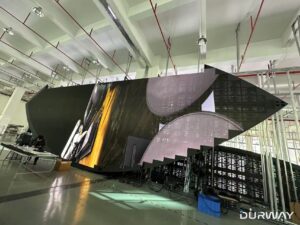
Does the screen need to be part of a larger structure? Panora modules can form corners, columns and right-angle creative shapes, so a round screen does not have to stand alone. If the project includes a column wrap or a corner display, the round screen can be designed as part of the same system.
What Should the Installation and Maintenance Plan Cover?
A round LED screen is a piece of suspended equipment in a public space, so the installation plan deserves the same attention as the screen itself. The checklist below covers the points that most often cause delays.
- Confirm the mounting structure. Check the ceiling or support frame can carry the screen’s weight, and confirm the fixing points with a structural engineer before installation day.
- Check power and data routes. Confirm where power and the control signal will run, and make sure the routes are agreed with the venue before the screen is hung.
- Verify the control system. NovaStar is the default controller for the Panora; other brands can be fitted per customer requirements. Confirm which controller the project will use and that the content management workflow fits the operator’s team. No specific controller model is promised in advance.
- Plan the content in advance. Design the first content loop before the screen arrives, in the correct circular format, and test it at full size on a computer screen before installation day.
- Test under real lighting. Switch on the screen under the space’s normal lighting, including any daylight, and check legibility from the main approach routes, not just from directly underneath.
- Record the certifications. The Panora carries ETL, TUV-CE, FCC, CB, EAC and RoHS certifications. Keep the certificates on file; exhibition venues and retail landlords often ask for them before allowing installation.
Where Does a Round LED Screen Work Best?
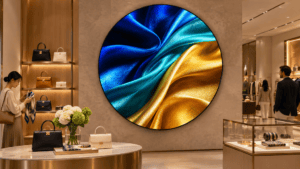
Round LED screens work best where people move freely and where the display needs to be noticed from many directions at once. Retail is the clearest example: a circular screen above a central display table or in a store entrance acts as a beacon that draws shoppers towards a promotion, a new collection or a brand story. Because the shape itself is unusual, it also photographs well, which matters for stores that want customers to share images of the space.
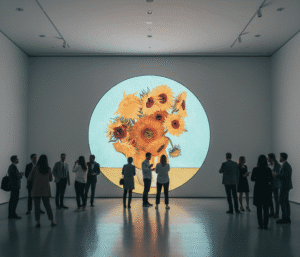
Museums and cultural venues use circular displays for orientation and atmosphere, and architectural environments — hotel lobbies, airport lounges, corporate headquarters — use them in a similar way, as a design feature that also carries information.
Frequently Asked Questions
What is the difference between a round LED screen and a flat LED panel?
A flat panel is designed to be viewed from one direction, while a round LED screen shows content across a full 360-degree field, so it is visible from every side. The round shape also makes the screen a design feature in its own right, which suits open-plan retail and exhibition spaces where people approach from many directions.
What sizes does the Panora round LED screen come in?
Four diameters: 480, 960, 1440 and 1920 mm. All four share the same 2.5 mm pixel pitch, SMD1010 Black pixels, GOB surface, 600–800 nits brightness and 5000:1 contrast, so image quality is the same at every size and the choice is about fitting the space.
Can a round LED screen be maintained from the front?
Yes. The Panora supports front maintenance, and it also supports rear maintenance. Magnetic mounting and a modular design make it possible to service individual modules without dismantling the whole screen, which is important when the screen hangs in a public space.
How long will a round LED screen last?
The Panora’s expected durability is 5–8 years, and the typical warranty is 2–3 years, extendable on request. Durway provides 24/7 online support, customer training, custom service and after-sales repair. The screen’s GOB surface is waterproof, dustproof and moisture-proof.
What control system does the Panora use?
NovaStar is the default controller, and other brands can be fitted per customer requirements. No specific controller model is promised in advance; the choice is confirmed with the project team during planning.
A Circle That Works as Hard as It Looks
A round LED screen earns its place in a retail or exhibition space by solving a real problem: how to be seen from everywhere in a room where people move in every direction. Choose the size by the space and the viewing distance, plan the content for the circle, and confirm the mounting, power and support plan before installation day.
We turn clients’ concepts into reality.
For specifications, quotations and project advice, contact Durway at info@durway.com.