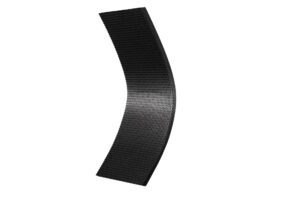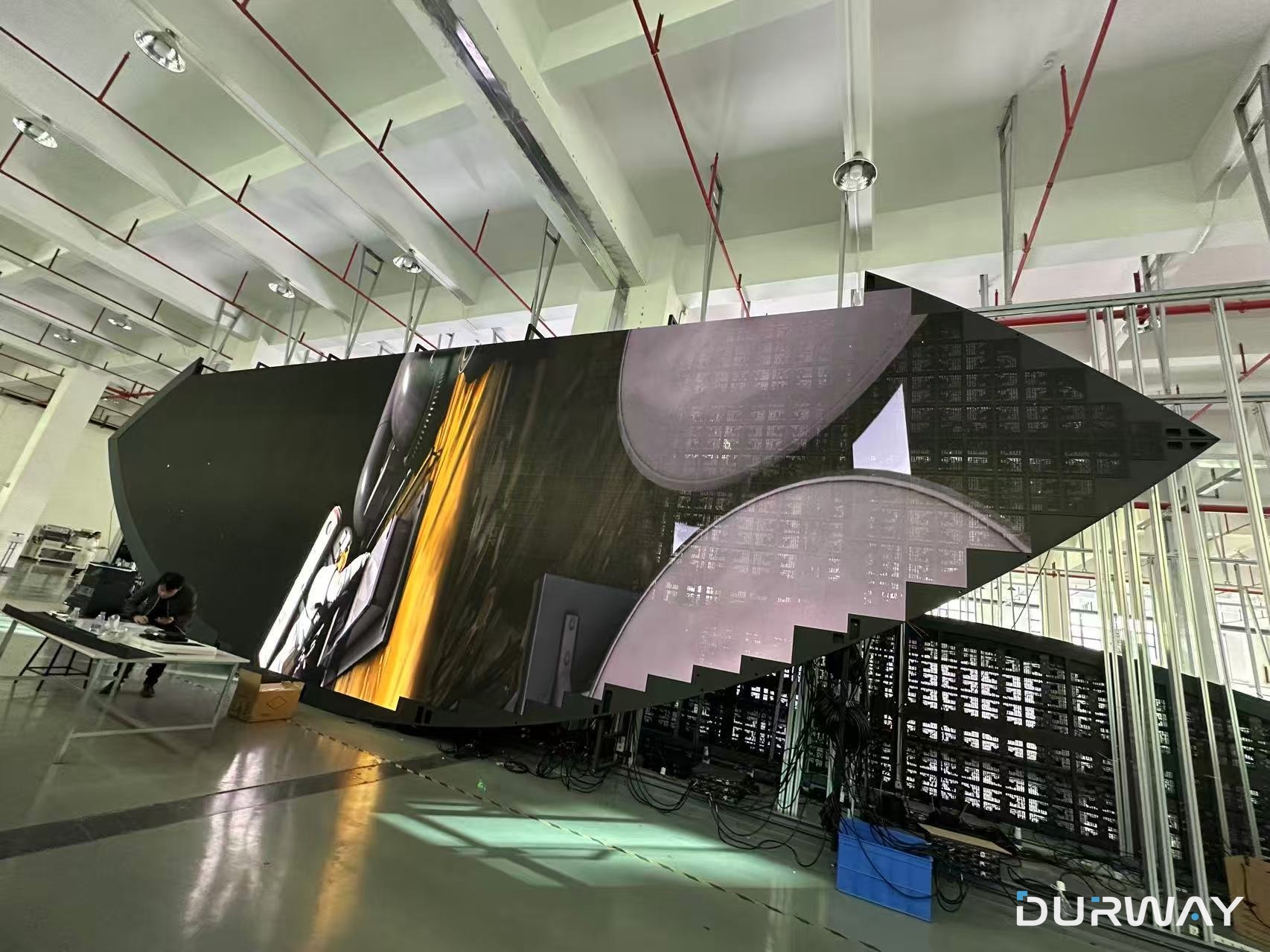
An acoustic transparent LED screen is a direct-view LED wall built so that sound from loudspeakers mounted behind it can pass through the display surface and reach the audience. The speakers sit where the picture is — behind the screen — so voices and effects come from the image itself instead of from speakers above, below or beside it. Durway’s EchoFlex range does this with lightweight 400 × 300 mm tiles at 1.5625, 1.923 and 2.5 mm pixel pitch, which can be installed flat or curved to a 600 mm radius and serviced from the front or the rear.

Why put speakers behind the screen at all?
Cinema solved this problem decades ago. In a film theater, the centre channel — dialogue, and most of what anchors a scene — is played through speakers behind a perforated projection screen, so the words come from the actors’ faces, not from the ceiling. Audiences never think about it until it is wrong: when the voice and the mouth are in different places, the illusion thins.
Direct-view LED broke that arrangement. An LED wall is a solid surface, so when a venue replaces projection with LED, the speakers have to move — above the screen, below it, or to the sides — and the sound detaches from the picture. Designers then compensate with delays, extra fill speakers and careful tuning, but the geometry is working against them, especially in immersive rooms where the screen wraps around the audience.
An acoustic transparent LED screen restores the cinema arrangement on an LED wall: it makes the LED screen speakers-behind-display layout possible again, with the centre and front channels behind the image.
How can sound pass through an LED screen?
Sound is a pressure wave travelling through air. It passes through a surface only if the surface gives it a path: a solid, sealed panel reflects and absorbs it, which is why a conventional LED wall blocks the speakers behind it. Perforated cinema screens work because the projection surface is full of tiny openings — the picture is reflected from the solid fraction, the sound travels through the open fraction.
EchoFlex applies the same principle to a direct-view LED tile. The tile’s light-emitting surface is engineered to be acoustically open rather than a sealed sheet, so sound pressure from the speakers mounted directly behind the wall passes through the display instead of being trapped behind it. Lower frequencies pass readily — long wavelengths are barely obstructed by the tile structure — and the open construction keeps the path clear across the audible range, so the front soundstage stays coherent: dialogue, music and effects arrive from the same direction the audience is looking.
Two practical consequences follow. First, there are no speaker shadows or reflections to design around, as there can be with projection. Second, the audio design returns to first principles: the venue’s audio team places the front speakers where the acoustics want them — behind the picture — and tunes the room, rather than working around the screen.
The three EchoFlex models, compared
EchoFlex is a tile system, not a fixed cabinet. All three models share the same 400 × 300 mm tile format, a 600 mm minimum curve radius, front and rear maintenance, and a calibrated brightness of 600 nits, which suits the controlled-light environments these screens are built for. Colour performance is specified at company level as greater than 99% of the DCI-P3 gamut, with 16-bit grayscale (65,536 levels), a refresh rate of 1,920–3,840 Hz and frame rates of 59.94, 60 and 120 Hz across the range.
| Model | Pixel pitch | Pixels per tile | Pixel density | Tile weight | Typical use |
|---|---|---|---|---|---|
| EFP1.5 | 1.5625 mm | 256 × 192 | 409,600 dots/m² | 1.56 kg | Closest viewing; premium theater and experience rooms |
| EFP1.9 | 1.923 mm | 208 × 156 | 270,422 dots/m² | 1.45 kg | Immersive theaters and planetariums at mid-range distances |
| EFP2.5 | 2.5 mm | 160 × 120 | 160,000 dots/m² | 1.45 kg | Larger surfaces viewed from further back |
Each tile weighs under 1.6 kg, and the tiles mount magnetically, which keeps the supporting structure light and makes individual tile replacement straightforward. The rated LED life is 100,000 hours at 50% brightness, and the system is rated IP30 for indoor use.

Flat, concave or convex: what shapes can it take?
Because the display is assembled from tiles rather than rigid cabinets, an EchoFlex wall can be flat, concave (wrapping toward the audience) or convex, following curves down to a 600 mm radius. That is what makes the system suitable for immersive geometry: planetarium-style curved walls, cylindrical features and wave forms, where a flat cabinet wall would facet. The speaker layout follows the same geometry — the front speakers sit behind the curved surface, so the sound field wraps with the picture.
The choice of shape is made at drawing stage, together with the audio design. Radius, seating positions and speaker placement are three views of the same decision, and they should be confirmed before the structure is designed.

What else is in the system?
An EchoFlex installation is a six-part system: the LED tiles, the RV (receiving) box, power cables, the controller, the power supplies and the data cables. Two parts deserve a buyer’s attention:
- Power. EchoFlex uses low-voltage remote power — the supplies sit away from the finished surface, which is safer and keeps heat and a common failure point off the screen. Fanless indoor power supply options (Taiwan Meanwell units) suit noise-sensitive rooms such as theaters, where a fan behind the screen would be audible in quiet passages.
- Control. Durway supplies NovaStar control as the default; other ecosystems such as Colorlight or Brompton can be fitted to the client’s requirements, with the specific configuration confirmed at proposal stage.
For completeness, the items the client provides should be named at the same stage: the video content, the media server and the venue’s technical personnel. An acoustic screen solves the sound-and-picture problem; the content pipeline behind it is a separate, client-side scope that a good proposal states explicitly rather than assumes.
Where is an acoustic LED screen used?
The pattern is always the same: a room where the audience must believe the sound and the picture are one thing.
- Planetariums and astronomy theaters, where a curved screen carries the sky and narration must come from the dome, not from a visible speaker.
- Immersive theaters and experience centres, where the image wraps the room and any detached sound source breaks the effect.
- Cinemas and premium screening rooms moving from perforated projection screens to direct-view LED without giving up behind-screen audio.
- Auditoriums and houses of worship, where speech clarity depends on the voice arriving from the person on screen.
The reference installation is the Lowell Universe Theater at Lowell Observatory in Flagstaff, Arizona, where a 1.9 mm EchoFlex acoustic LED screen was installed in cooperation with Skyskan: the picture and the hidden speaker system occupy the same curved wall, so narration and effects come from the sky the audience is watching.
How is an acoustic LED screen installed and commissioned?
Installation starts with the structure and the speaker array, not with the tiles. The supporting frame is built to the agreed geometry — flat or curved — and the front speakers are mounted behind the screen position, on the axis the audio design specifies. The tiles then fix magnetically to the structure, section by section; at under 1.6 kg per tile, handling is a two-person job without lifting equipment, and alignment is adjusted as the surface grows. Power supplies are placed remotely, away from the finished wall, and cabled back to it — in a theater this also keeps supply fans out of the room’s noise floor.
Commissioning has two halves that are usually separate trades: the display is calibrated as a normal fine-pitch wall (brightness and colour uniformity across the full surface), and then the audio system is tuned in the room with the screen in place, so the measured sound is the sound through the finished display, not through an open frame. Buyers should make sure both halves are in the same commissioning plan — an acoustic screen that is only ever tested as a picture has not been tested as a system.
How to specify an acoustic transparent LED screen, step by step
Step 1 — Design the sound and the picture together. Bring the audio designer into the project at drawing stage. Speaker positions behind the screen, seating layout and screen shape are one decision, not three.
Step 2 — Set the pixel pitch from the nearest seat. Use the closest viewing distance to choose between 1.5625, 1.923 and 2.5 mm. In a theater the front row decides; in an experience centre it is the nearest standing position.
Step 3 — Fix the geometry. Confirm flat, concave or convex, and the radius (600 mm minimum). The structure is designed from this, and the speaker layout follows it.
Step 4 — Decide the maintenance direction. EchoFlex tiles support front and rear maintenance. If the wall is sealed against a finished structure, specify front access; if a service cavity exists behind the speakers, rear access keeps the viewing surface untouched.
Step 5 — Confirm the client-supplied scope. Content, media server and technical personnel are the client’s side of the system. Name them in the proposal so the commissioning plan is complete.
Acoustic transparent LED screens: frequently asked questions
Does the sound lose quality passing through the screen?
The tile surface is engineered to be acoustically open, following the same principle as the perforated screens cinemas have used for decades: the sound passes through the display structure instead of being blocked by it. Final tuning is done by the venue’s audio team in the room, as with any theater installation.
Can any speakers be placed behind the screen?
The front and centre channels are the ones that belong behind the picture; subwoofers and surround channels follow the room’s audio design as usual. Speaker selection and placement remain the audio designer’s scope — the screen’s job is to not stand in their way.
Can an acoustic LED screen be curved?
Yes. EchoFlex tiles follow curves down to a 600 mm radius, concave or convex, as well as flat walls. The curved geometry is also where behind-screen audio matters most, because the sound field can follow the wrap of the image.
How is the screen maintained if the speakers are behind it?
Tiles are accessible from the front or the rear, and mount magnetically, so a tile can be removed and replaced without dismantling the wall or the speaker array. The maintenance direction is chosen at specification stage.
How bright is it, and does it suit a dark theater?
600 nits after calibration — specified for controlled-light venues rather than sunlit spaces. In a darkened theater that is ample, and the 5,000:1 contrast ratio and matt, fine-pitch surface are what carry the image.
Durway designs and manufactures acoustic transparent LED screens for venues where the picture and the sound have to occupy the same wall. We turn clients’ concepts into reality. For drawings review or a project discussion, contact us at info@durway.com.