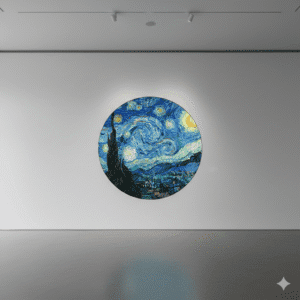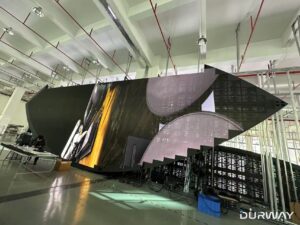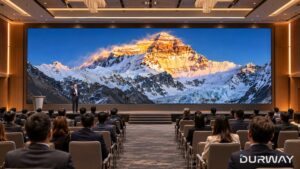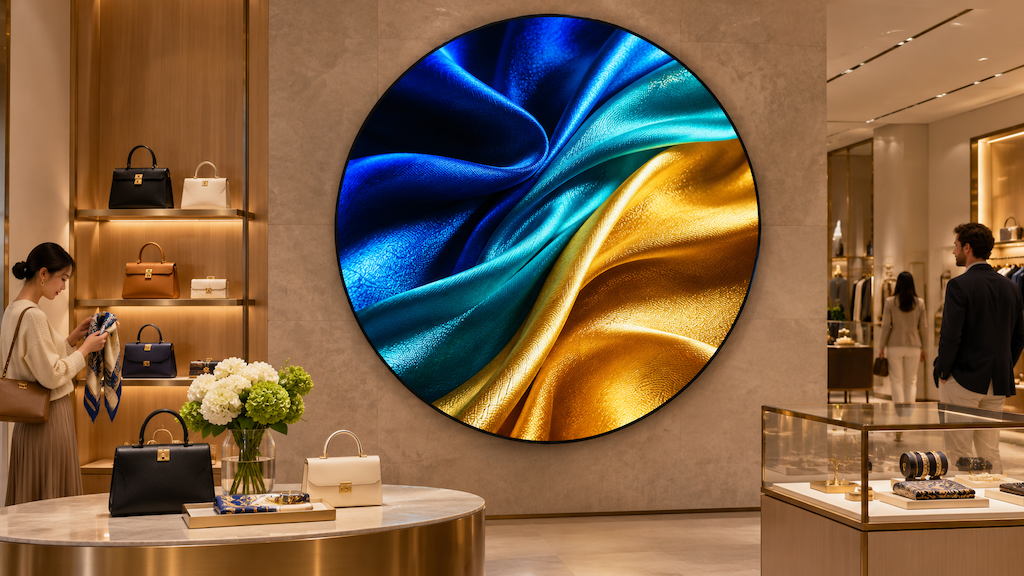
A round LED screen shows content across a full 360-degree field, so it can be read from any direction. Durway’s Panora comes in four diameters — 480, 960, 1440 and 1920 mm — all with a 2.5 mm pixel pitch, a protective GOB surface and front maintenance.
How Does 360° Viewing Actually Work?
A round LED screen works the same way any LED display works: thousands of light-emitting diodes form the pixels of the image, and a control system tells each one what colour and brightness to show. The difference is the geometry. On the Panora, the LED modules are arranged in a circular layout, so the image wraps around the full 360 degrees and the screen has no front or back.
Two things make that work in practice. First, the design is frameless and seamless, so no visible border breaks the image as the eye moves around the disc. Second, wide-angle calibration keeps colour and brightness consistent from every viewing position. The viewing angle is 160 degrees both horizontally and vertically, and the best viewing distance is 7.62 metres — so a visitor approaching from any side sees the same content at the same quality.
What Does the GOB Surface Do?
GOB stands for glue-on-board: a protective coating over the LED modules. On the Panora it is waterproof, dustproof and moisture-proof, and it makes the display face more resistant to knocks than an unprotected LED surface.
That matters because round screens usually hang in public, high-traffic spaces, where the screen can be bumped or splashed. GOB is practical protection for commercial use. It does not change picture quality: brightness stays at 600–800 nits and the contrast ratio is 5000:1.
How Does Front Maintenance Work, and What About Magnetic Mounting?
The Panora supports front maintenance, and also rear maintenance. Front maintenance means a technician can service the screen from the front without taking it down — important when it hangs in a public space, where access from behind may be impossible.
Magnetic mounting holds each module firmly in place while allowing it to be removed by hand during servicing. With the ultra-thin, lightweight modular design, installation and maintenance stay straightforward: the screen goes up quickly, and a faulty module can be swapped without dismantling the display.
What Are the Four Sizes, and How Do I Choose?
All four Panora models share the same core specification — 2.5 mm pixel pitch, SMD1010 Black pixels, GOB surface, 600–800 nits brightness, 160-degree viewing angle and 5000:1 contrast — so image quality is identical at every size.
| Feature | Panora 480 | Panora 960 | Panora 1440 | Panora 1920 |
|---|---|---|---|---|
| Diameter | 480 mm | 960 mm | 1440 mm | 1920 mm |
| Pixel pitch | 2.5 mm | 2.5 mm | 2.5 mm | 2.5 mm |
| Surface | GOB | GOB | GOB | GOB |
| Brightness | 600–800 nits | 600–800 nits | 600–800 nits | 600–800 nits |
| Viewing angle | 160° H / 160° V | 160° H / 160° V | 160° H / 160° V | 160° H / 160° V |
| Contrast | 5000:1 | 5000:1 | 5000:1 | 5000:1 |
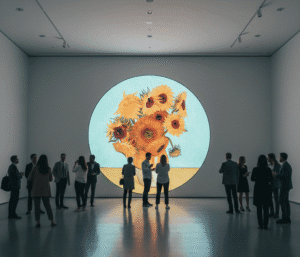
The 480 mm model is an accent piece — a brand mark above a counter. The 960 mm model suits a shopfront window, a reception area or a modest exhibition stand. The 1440 mm model anchors a retail atrium or a mid-sized exhibition space. The 1920 mm model, nearly two metres across, suits a flagship store or a museum entrance hall.
Choose by ceiling height and viewing distance: a suspended disc must leave clearance below it for people to pass, and a large disc needs a generous ceiling. The 7.62 m best viewing distance is a useful guide.
Can a Round Screen Do More Than a Circle?
Yes. The Panora’s modules can form corners, columns and right-angle creative shapes, so a round screen does not have to stand alone. A disc can sit atop a column, be set into a curved wall, or join other LED elements in a wider installation.
The circle is a starting point, not a limitation. Discuss the shape with the project team early, because custom shapes are planned per project and details are confirmed on inquiry.
What Control System Does the Panora Use?
NovaStar is the default controller, and other brands can be fitted per customer requirements. No specific controller model is promised in advance.
The practical question is how content will be managed day to day — who updates the loop, and from where. Confirm the controller choice and the content workflow before installation, so the operator’s team can change content without calling a technician every time.
How Long Will It Last, and What Does the Warranty Cover?
The Panora’s expected durability is 5–8 years, and the typical warranty is 2–3 years, extendable on request. Durway provides 24/7 online support, customer training and after-sales repair.
The GOB surface helps the screen survive daily use in public spaces, and the modular design means a single worn module can be replaced rather than the whole screen. Keep the warranty terms and the certifications — ETL, TUV-CE, FCC, CB, EAC and RoHS — on file, because venues and landlords often ask for them. The colour gamut is greater than 99% DCI-P3, a wide colour standard used in professional video and photography.
What Content Works Best on a Circle?
Content designed for a circle works best: brand logos, rotating product imagery, animated graphics, countdowns and short looping video. Attention falls on the centre of the disc, so put the key message there and keep text short and large, with high-contrast imagery.
Dense text and wide-format video are designed for rectangles and do not translate well to a circle. Design the first loop before the screen arrives, in circular format, and test it at full size — then check legibility under the space’s real lighting, from the main approach routes.
Before You Order: A Short Checklist
- Measure the space — ceiling height and clearance below the suspended disc.
- Pick the diameter by viewing distance — use the 7.62 m best viewing distance as a guide.
- Confirm mounting and access — suspension structure and front maintenance access.
- Decide the control system — NovaStar is the default; confirm the choice and the content workflow.
- Design the content for a circle — plan the first loop in circular format before installation day.
- File the paperwork — warranty terms and the ETL, TUV-CE, FCC, CB, EAC and RoHS certifications.
A round LED screen earns its place by being seen from everywhere in a room where people move in every direction. Choose the size by the space, plan the content for the circle, and confirm the mounting and support plan before installation day.
We turn clients’ concepts into reality.
For specifications, quotations and project advice, contact Durway at info@durway.com.