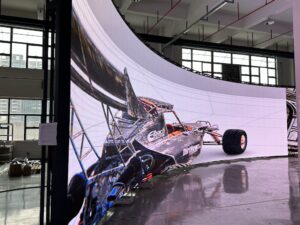
In short: An acoustic display is an LED screen built so that sound passes through the image itself. The main speakers sit behind the display instead of beside, above or below it, so dialogue and effects reach the audience from the same place as the picture. A fine-pitch acoustic transparent LED screen does this at pixel pitches of 1.5625–2.5 mm — fine enough for audiences sitting a few metres from the surface — which is why theaters, planetariums and immersive venues choose it when the voice has to come from the screen, not from the room.
What Is an Acoustic Display?
In professional AV, an acoustic display is a display surface that is acoustically transparent: it lets sound from speakers positioned behind it travel through to the audience instead of blocking it or bouncing it back. The idea is borrowed from cinema, where perforated projection screens have hidden the centre speaker behind the picture for decades — only here the surface is a self-emissive LED wall rather than a projection fabric, so the venue keeps the behind-screen speaker layout and gains the brightness, contrast and geometry freedom of LED.
Two confusions are worth clearing up before anything else. An acoustic display is not a transparent LED screen. A transparent LED is see-through — it is made to be looked through, at the space behind it. An acoustic display is made to be looked at; its job is to pass sound, not light, and from the seats it reads as a solid, seamless picture. Nor is an acoustic display a loudspeaker in disguise: the screen produces no sound itself. The loudspeakers behind it are ordinary loudspeakers, designed as part of the room’s audio system; the display is simply engineered not to stand in their way.
For the fuller technical background, see our guide to what an acoustic transparent LED screen is and how sound passes through it.
How Does an Acoustic Display Work?
A standard LED wall is a solid surface, and solid surfaces are where sound goes to die. Fire a speaker at the back of one and the energy is reflected into the cavity behind the wall or absorbed by it; what escapes around the edges arrives late and coloured. That is why speakers end up flanking the picture on standard LED projects — and why the voice then arrives from the left or the right while the face speaking it is in the middle of the screen.
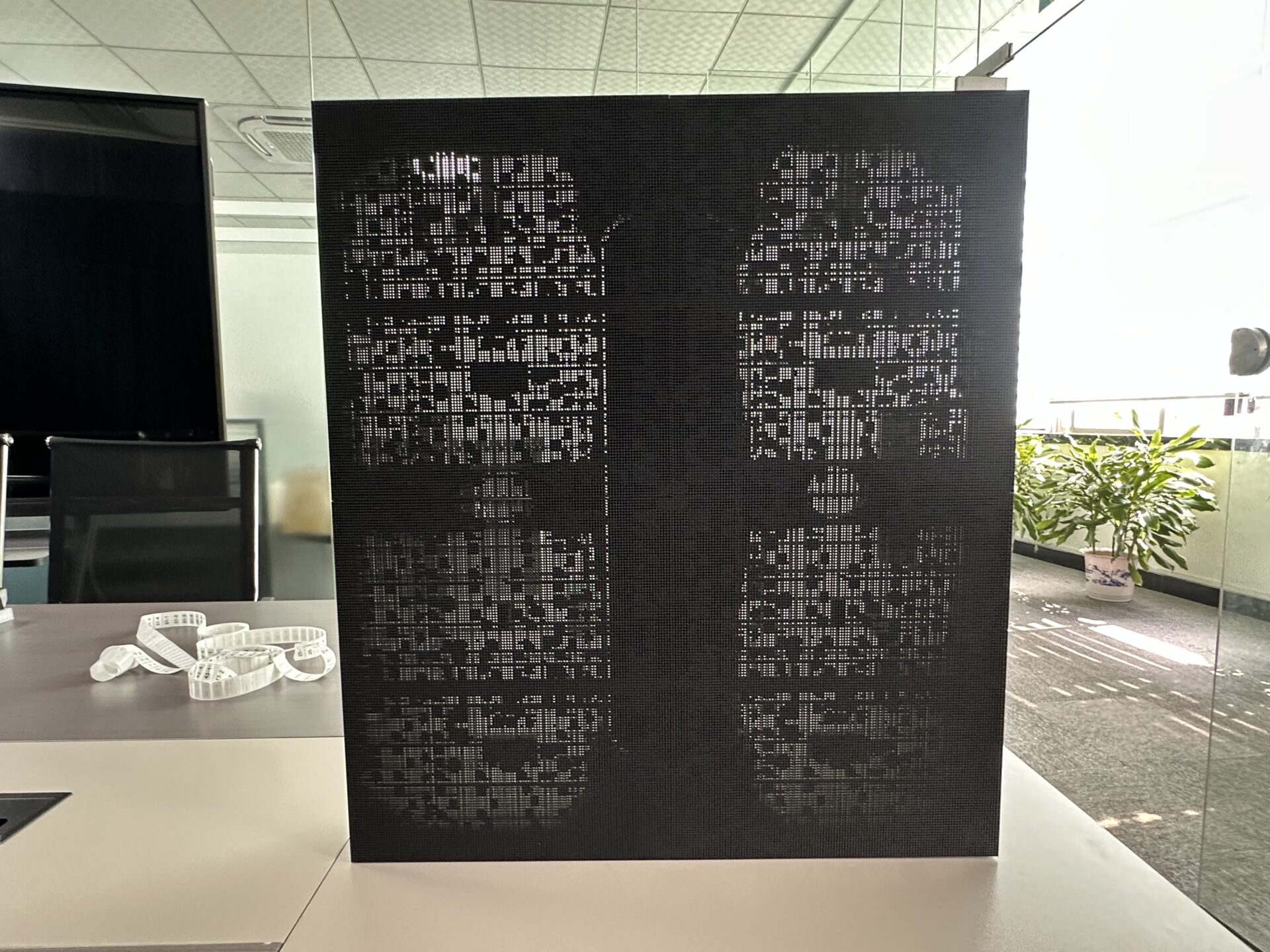
An acoustic display is built the other way round: the LED tiles carry an open structure, in and between the modules, and the sound from the speakers behind passes through that open area and out of the picture surface. The audience localises the voice on the image itself, which is the entire point — dialogue tracks the actor, narration tracks the planetarium sky, and no speaker hardware competes with the picture for attention.
The engineering trade is between open area and image density. The more open the structure, the more freely sound passes; the finer the pixel pitch, the closer the audience can sit before individual pixels show. EchoFlex is built at the fine-pitch end of that trade — 1.5625, 1.923 and 2.5 mm — so the screen holds up at theater viewing distances and still passes sound. Open area is a per-model figure, not a range-wide one: in the EchoFlex range, the 2.5 mm model reaches an open-area ratio of 18–20%, the highest in the current range. When you compare products, ask for the figure for the exact model you are buying, not the best number in a brochure.
The display itself is a six-part system: LED tiles, an RV box, power cable, a controller — NovaStar by default, with other brands fitted to customer requirements — power supplies, and data cable. Power is low-voltage and remote, with fanless supply options, which keeps heat and fan noise away from a quiet auditorium. The speakers are the venue’s side of the design and sit in the cavity behind the tiles. Full specifications are on the EchoFlex acoustic transparent LED screen product page.
[IMAGE: EchoFlex acoustic display in a theater, speakers mounted behind the fine-pitch screen — owner to add]
Acoustic Display, Standard LED Wall or Distributed Speakers?
Most venues weigh three ways of solving the same problem — where the sound comes from — and the honest answer depends on the content the room exists for.
| Question | Acoustic display | Standard LED wall, speakers beside it | Distributed speakers around the room |
|---|---|---|---|
| Where do the main speakers sit? | Behind the screen | Flanking, above or below the screen | Spread around walls and ceiling |
| Where does the voice seem to come from? | From the image itself | From beside the image | From everywhere — and nowhere in particular |
| Picture surface | Fine-pitch LED, seamless at close range | Fine-pitch LED | Any display; the sound is a separate system |
| Visible hardware in the room | None — the speakers are hidden | Speaker stacks or line arrays in view | Many small speakers in view |
| Best suited to | Theaters, planetariums and immersive rooms where dialogue must track the picture | Presentations, signage and general content where exact sound localisation matters less | Background music, paging and ambient audio |
| The compromise | Needs a cavity behind the screen for speakers and service | Sound and picture are physically separated | No single point of origin for dialogue |
Which Pixel Pitch Does an Acoustic Display Need?
Choose by the nearest seat, not the average one: the front row decides how fine the pitch has to be, and the pitch decides which model in the range you are specifying.
| Model | Pixel pitch | Pixels per m² | Suited to |
|---|---|---|---|
| EFP1.5 | 1.5625 mm | 409,600 | The closest seating — small theaters, screening rooms, front rows near the screen |
| EFP1.9 | 1.923 mm | 270,422 | Mid-size theaters and planetariums — the pitch installed at Lowell Universe Theater |
| EFP2.5 | 2.5 mm | 160,000 | Larger venues with more distance to the front row; also the range’s highest open-area ratio, at 18–20% |
All three models share the same 400 × 300 mm tile, the same 600 mm minimum curve radius and front-or-rear service access, so the structure is designed once and the pitch is picked for the room. The picture figures are held constant across the range: 600 nits calibrated brightness, a 5,000:1 contrast ratio, colour temperature adjustable from 2,600 to 9,500 K for matching house light or cameras, and colour gamut greater than 99% DCI-P3.
When Does a Venue Need an Acoustic Display?
Not every room does — a signage wall gains nothing from it. The case becomes strong when several of these are true of yours:
- Dialogue has to come from the screen. In a theater or planetarium show, a narrator’s voice arriving from a side wall quietly breaks the illusion the picture is building. The closer the audience sits, the more noticeable the offset.
- There is no good place to put speakers. Curved, wraparound and dome geometries leave no flat wall beside the image, and speaker stacks would block sightlines — or the screen itself.
- The room is being rebuilt around LED. A venue replacing a perforated projection screen with an LED wall keeps its behind-screen speaker layout only if the LED passes sound; otherwise the audio design has to start again.
- The speakers must stay invisible. Design-led spaces — museums, science centres, brand theaters, houses of worship — often rule out visible line arrays on appearance alone.
- The screen is also the acoustic centre of the show. Immersive and simulation environments place effects and voices at points on the image; that only works if the sound can originate there.
If the content is mostly presentations, signage or ambient video, a standard LED wall with well-placed speakers is usually the simpler and better answer. The acoustic LED screen FAQs cover the follow-up questions buyers tend to ask at exactly this point.
Six Steps to Decide
- Start with the sound, not the screen. Write down where the main speakers must sit for the show to work. If the answer is “behind the picture”, you are specifying an acoustic display; if not, you probably are not.
- Measure the nearest seat. The distance from the screen to the front row sets the pitch: the closest rows point to 1.5625 mm, a mid-size room to 1.923 mm, a larger hall to 2.5 mm.
- Check the cavity. The speakers — and room to reach them — must fit behind the screen. EchoFlex tiles are magnetic and serviceable from the front or the rear, which relaxes the access question, but the speakers still need their space planned.
- Decide flat or curved. The tiles build concave, convex and cylindrical surfaces down to a 600 mm radius. The geometry is fixed at drawing stage, because the structure is what holds the curve.
- Plan the whole system, including your side. The display system — tiles, RV box, cabling, controller and power — is the supplier’s side. Video content, the media server and the technicians who run the show are the venue’s side; agree in writing who supplies what before ordering.
- Ask for the exact model’s figures. Open-area ratio, pixel density and resolution differ per model. Compare the model you will actually receive — not the best figure quoted anywhere in the range.
A Working Example: Lowell Universe Theater
At Lowell Universe Theater in Flagstaff, Arizona, the installed screen is a 1.9 mm EchoFlex acoustic display. The speakers sit behind the fine-pitch surface, so the narration of the planetarium show comes from the image the audience is watching, in a room whose geometry would have fought a conventional speaker layout at every step. It is the reference we give buyers who would rather hear the arrangement working than read about it — the full case study is at Lowell Universe Theater.
[IMAGE: The EchoFlex acoustic screen at Lowell Universe Theater, Flagstaff — owner to add]
Frequently Asked Questions
Is an acoustic display the same as a transparent LED screen?
No. A transparent LED screen is see-through — it is designed so the space behind it stays visible. An acoustic display is a full picture surface designed so that sound passes through it. The two properties solve different problems, and they are specified separately.
Does the sound lose quality passing through the screen?
Any surface in the sound path has some effect, which is why the honest figure to compare is the open-area ratio of the exact model in front of you. In the EchoFlex range, the 2.5 mm model reaches an open-area ratio of 18–20%, the highest in the current range. Treat any single transmission percentage quoted for a whole range of pitches with caution.
Can an acoustic display be curved?
Yes. EchoFlex tiles build concave, convex and cylindrical surfaces down to a 600 mm radius, which covers curved theater walls, planetarium surrounds and column wraps. The curve is set by the supporting structure and fixed at the design stage.
What pixel pitch should a theater choose?
Work from the nearest seat. Front rows a few metres from the screen point to 1.5625 mm; most mid-size theaters land on 1.923 mm — the pitch installed at Lowell Universe Theater; 2.5 mm suits larger rooms and carries the range’s highest open-area ratio.
What does the venue need to supply?
The display system itself — tiles, RV box, cabling, controller and power supplies — is the display supplier’s side. Video content, the media server and the operating technicians are the venue’s side, and the split should be agreed in writing before the order is placed.
How is an acoustic display maintained, and how long does it last?
The tiles are magnetic and can be serviced from the front or the rear, so a failed tile is swapped without dismantling the wall. LED lifetime is rated at 100,000 hours at 50% brightness, expected service life in venue use is 5–8 years, and warranty is typically 2–3 years, extendable. The range is an indoor product (IP30), with TUV-CE, FCC and RoHS certification.
Does an acoustic display need special content or playback equipment?
No. It is driven like any LED wall — 59.94, 60 and 120 Hz frame rates are supported — so existing show content and media servers carry over. The only thing that changes is where the sound comes from.
Start With the Room, Not the Screen
If your venue’s sound has to come from the picture, the specification starts with three facts: the size and shape of the room, the distance to the nearest seat, and where the speakers need to live. Send us those, and we will come back with the pitch and configuration that fit.
We turn clients’ concepts into reality.
For specifications, quotations and project advice, contact Durway at info@durway.com.