Project Overview
The Lowell Universe Theater at Lowell Observatory in Flagstaff, Arizona features a large-format fine-pitch acoustic transparent LED display designed for immersive astronomy visualization, live presentations, and science education.
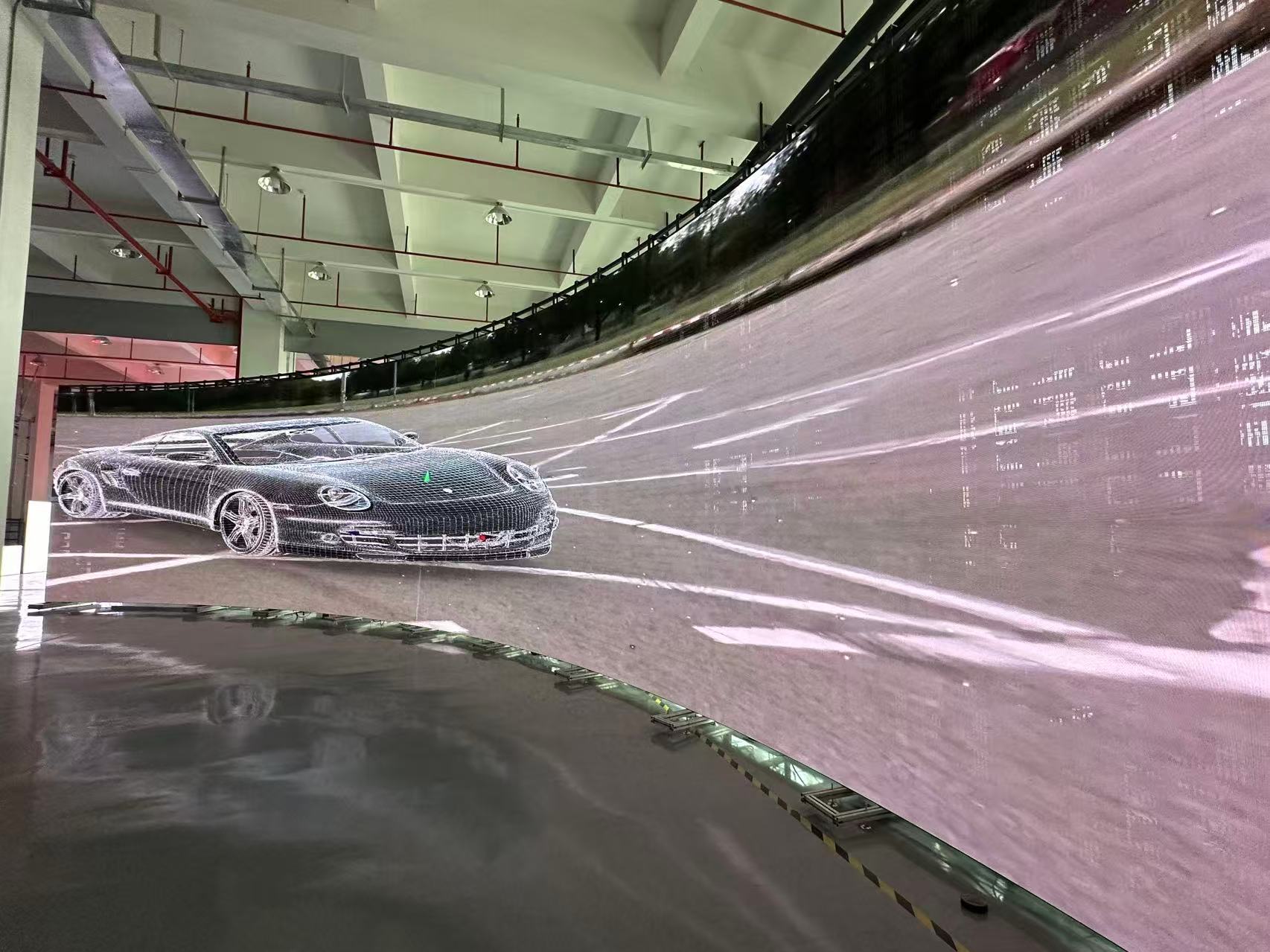
The theater is part of the Marley Foundation Astronomy Discovery Center, which opened in 2024. At the center of the experience is a two-story, 160-degree curved 16K LED display that surrounds visitors with astronomical imagery while supporting live storytelling and educational presentations.
For this type of application, image quality alone is not enough. The display system must also work closely with the audio system, room design, content platform, and presentation environment.
That is why acoustic transparent LED technology became an important part of the solution.
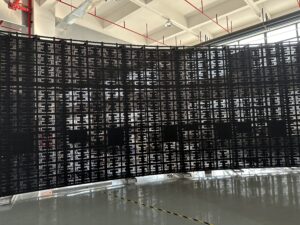
Why Acoustic Transparency Matters in Planetariums
In a traditional LED display, the screen itself creates a physical barrier between the audience and any loudspeakers located behind it.
For many commercial applications, this is not a major issue because the speakers can simply be installed above, below, or beside the screen.
In a planetarium or immersive theater, however, the relationship between image and sound is much more important.
When an object appears directly in front of the audience, the sound should feel as though it comes from the same position.
If the visual content is centered on the screen but the sound comes from the side or from another part of the room, the sense of immersion can be reduced.
A properly engineered acoustic transparent LED screen allows speakers to be positioned behind the display surface. This makes it possible for sound and image to originate from the same perceived location.
The result is a more natural and convincing immersive experience.
Why a Fine-Pitch Acoustic LED Screen Was Selected
Fine-pitch LED was selected because the audience views the screen at relatively close distances and the content includes highly detailed astronomical and scientific imagery.
Applications such as:
- Star fields
- Planetary surfaces
- Nebulae
- Deep-space imagery
- Scientific visualization
- High-resolution animation
- Live educational presentations
require a display with high pixel density and good image continuity.
A 1.9mm fine-pitch acoustic LED screen helps reduce visible pixel structure while maintaining strong detail reproduction across a large curved surface.
This is particularly important in a theater environment where the audience is not simply watching advertising content from a long distance, but is closely observing subtle scientific images and low-luminance visual details.
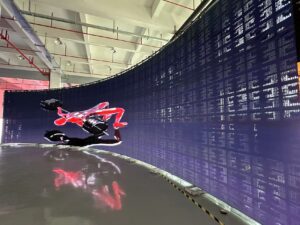
Challenges of Fine-Pitch Acoustic LED
Making an LED display acoustically transparent becomes increasingly difficult as pixel pitch becomes smaller.
At larger pixel pitches, there is more physical space between LEDs and electronic components, making perforation easier.
At fine pixel pitches such as 1.9mm, the engineering challenge becomes much greater.
The LED module must maintain:
- High pixel density
- Good image uniformity
- Structural integrity
- Precise module alignment
- Effective sound transmission
- Reliable heat dissipation
- Stable long-term operation
At the same time, the perforation structure must not introduce visible artifacts or significantly compromise the display surface.
The design therefore requires a careful balance between visual performance, acoustic performance, and mechanical reliability.
For planetarium and immersive theater applications, this balance is especially important because both image quality and sound localization directly influence the visitor experience.
LED vs Projection for Immersive Astronomy
Projection has traditionally been the dominant display technology in planetariums because it can cover very large curved surfaces.
However, LED technology is creating new possibilities for immersive astronomy applications.
Unlike projection, LED is self-emissive. There is no projector beam crossing the room, and presenters can stand in front of the display without creating shadows.
LED can also provide:
- High contrast
- Adjustable brightness
- Good image uniformity
- Stable color performance
- Excellent compatibility with live presentations
- Flexible integration with interactive and scientific content
For venues that combine immersive visualization with live presenters, science communication, educational programs, and interactive storytelling, LED can offer practical advantages over conventional projection.
The Lowell Universe Theater is a good example of how LED is becoming an increasingly serious visualization platform for observatories, science centers, museums, and planetariums.
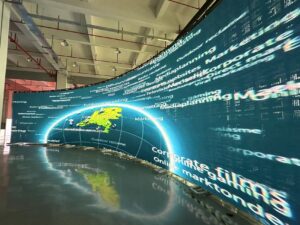
Why Customers Choose After Seeing the Real Display
One of the most important parts of the Lowell Observatory project is how the decision was made.
Before the project moved forward, our customer brought their own client to visit one of our previously completed LED installations.
After seeing the actual display performance in person, they decided to move forward with our solution, which ultimately led to the Lowell Observatory project.
We have seen the same pattern in other projects.
Another customer compared several LED suppliers, reviewed different technical proposals, and evaluated multiple display solutions. After seeing our screen in operation, they also selected our solution for their project.
This is important because professional LED systems cannot be evaluated by specifications and quotations alone.
Pixel pitch, refresh rate, grayscale performance, LED packages, driver ICs, and control systems all matter.
But customers also need to see how the complete system performs in a real environment.
A specification sheet can describe performance.
A completed installation demonstrates it.
Applications for Acoustic Transparent LED
Fine-pitch acoustic transparent LED can be used in a wide range of professional environments where image and sound need to work together.
Typical applications include:
- Planetariums
- Astronomy centers
- Science museums
- Immersive theaters
- Dome theaters
- Museums
- Simulation environments
- Corporate experience centers
- Broadcast and presentation spaces
- High-end visitor attractions
For these applications, acoustic transparency can help create a cleaner and more integrated audiovisual design while allowing the display to remain visually seamless.
Key Considerations When Selecting an Acoustic LED Screen
Selecting an acoustic LED screen involves more than choosing the pixel pitch.
For planetariums, immersive theaters, museums, and science centers, several factors should be evaluated together:
- Viewing distance and audience seating layout
- Required pixel pitch and image resolution
- Acoustic transmission performance
- Speaker positioning behind the display
- Low-grayscale and dark-scene image quality
- Module perforation design
- Structural precision for curved installations
- Color and brightness uniformity
- Maintenance access
- Long-term reliability and spare-parts strategy
For immersive environments, the best solution is usually the one that balances image quality, acoustic performance, structural design, and long-term serviceability, rather than optimizing only one specification.
FAQ
What is an acoustic transparent LED screen?
An acoustic transparent LED screen is designed with a perforated or acoustically optimized module structure that allows sound to pass through the display. This enables loudspeakers to be installed behind the LED screen.
Why is acoustic transparency important in a planetarium?
In a planetarium or immersive theater, sound should feel connected to the visual content. Acoustic transparent LED allows speakers to be positioned behind the image, helping improve sound localization and immersion.
Why use fine-pitch LED for planetarium applications?
Fine-pitch LED provides higher pixel density and smoother image reproduction at shorter viewing distances. This is important for scientific visualization, star fields, planetary imagery, and immersive educational content.
Can acoustic transparent LED replace projection?
In some applications, yes. LED can provide strong contrast, stable brightness, and freedom from projector shadows. However, the best choice depends on screen geometry, viewing distance, content requirements, budget, and room design.
What pixel pitch is suitable for an acoustic LED theater?
The ideal pixel pitch depends on viewing distance, screen size, audience layout, and content requirements. Fine-pitch solutions such as 1.9mm are suitable for applications where viewers are relatively close to the screen and high image detail is required.
Can acoustic LED screens be customized for curved installations?
Yes. Acoustic transparent LED can be engineered for curved, concave, cylindrical, and other custom display geometries, depending on the structural and acoustic requirements of the project.
Talk to Durway About Your Project
If you are planning a planetarium, immersive theater, astronomy center, museum, or science visualization project, Durway can help evaluate the right display architecture for your application.
We provide customized solutions including:
- Fine-pitch acoustic LED screens
- Curved and immersive LED displays
- LED dome systems
- Planetarium LED visualization solutions
- Custom mechanical structures
- Control and calibration system integration
Contact Durway at in**@****ay.com to discuss your project requirements, viewing distance, acoustic design, pixel pitch, and system configuration.