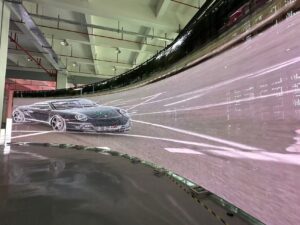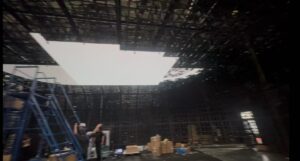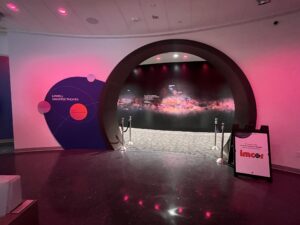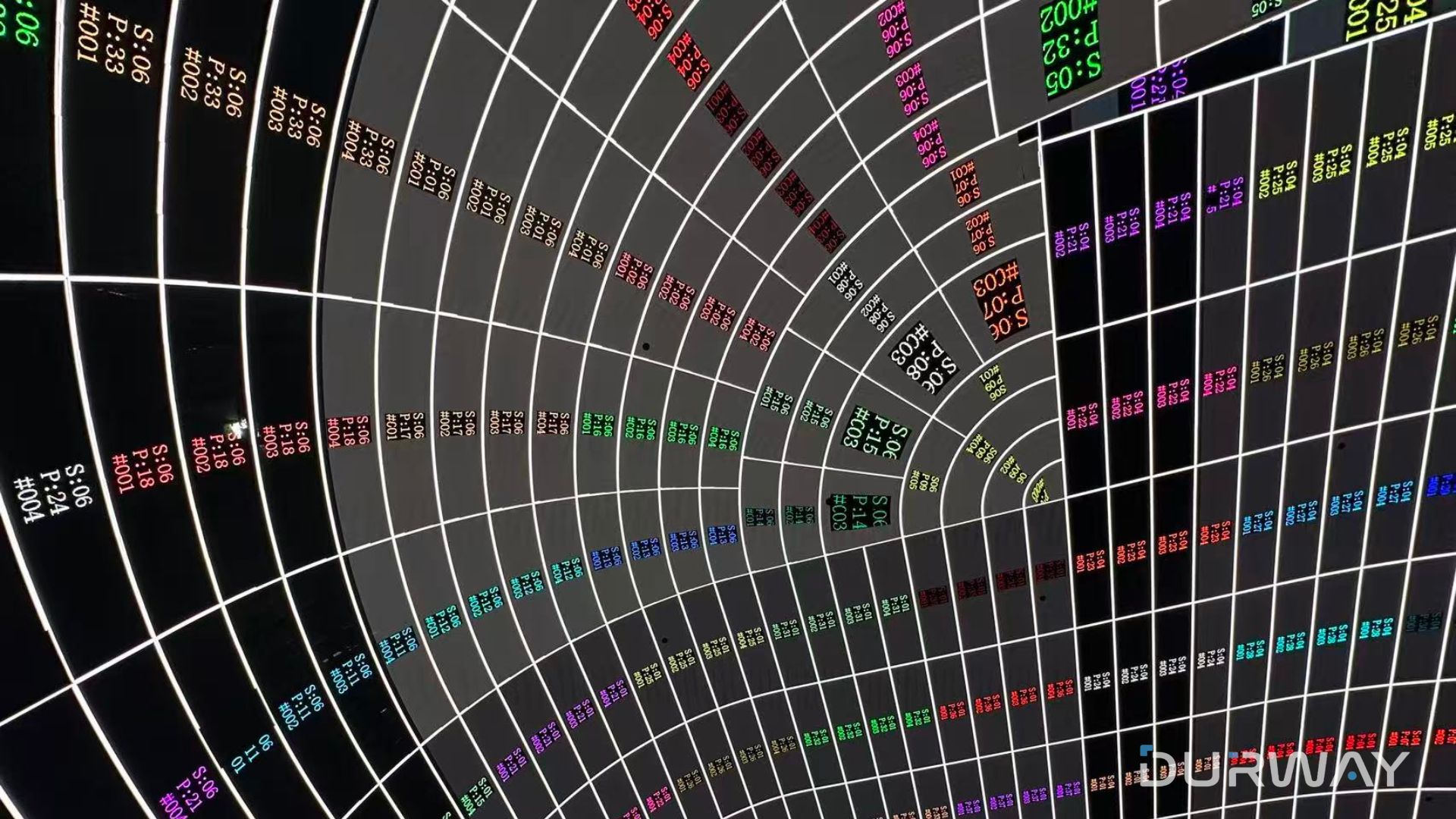
An immersive LED ceiling may look like one continuous digital surface when viewed from below. Behind that seamless appearance, however, lie hundreds of critical engineering decisions.
In a recent custom immersive LED project, the client did not want a conventional rectangular display simply attached to the ceiling. Instead, the LED system needed to follow the original architectural geometry and become an integrated part of the building itself.
To reproduce the complex ceiling accurately, more than 100 custom LED module types were required. The final design included 180 different module configurations, meticulously coordinated with the building’s structure, power distribution, fire-protection systems, and installation sequence.
This case demonstrates why a complex architectural LED display cannot be treated as a standard product purchase—it must be engineered as a complete, integrated system.
What Did the Client Want to Achieve?
The client’s primary objective was to create a continuous immersive environment where digital content could flow across the ceiling without being interrupted by the surrounding architecture.
The LED display needed to follow multiple high-to-low transitions, curved sections, and irregular boundaries. It could not appear to be an afterthought installed post-construction.
The intended result was an immersive LED ceiling that would:
- Follow the original architectural form accurately.
- Maintain visual continuity across complex structural transitions.
- Integrate seamlessly with lighting and life-safety systems.
- Preserve maintenance access for future servicing.
- Support reliable long-term operation.
- Feel like an organic part of the physical space.
This meant that standard product specifications—such as pixel pitch, brightness, and refresh rate—were not the starting point. The project had to begin with the architectural geometry and the ultimate audience experience.
Why Was This Immersive LED Ceiling So Difficult to Engineer?
1. Navigating Complex Geometric Transitions
Standard LED cabinets and modules are designed for flat walls or simple curved surfaces. This ceiling, however, featured multiple changes in height, direction, and curvature.
Using only standard modules would have created visible gaps, incorrect transitions, or major deviations from the architect’s vision. Every geometric zone had to be evaluated separately to determine:
- Module shape and specific dimensions
- Curvature and precise installation angles
- Seamless connections with adjacent modules
- Flawless pixel alignment
- Structural interfaces and cable routing
The challenge wasn’t just producing unusual shapes; all 184 custom LED module types had to operate together as one unified display.
2. Integrating Essential Life-Safety Systems
An architectural LED ceiling cannot obstruct a building’s fire-protection and emergency systems. This project required the integration of sprinklers, smoke detectors, emergency lighting, and other critical interfaces.
In total, 34 dedicated openings had to be coordinated with the LED surface. Simply cutting holes into completed standard modules would have ruined the visual continuity and compromised structural integrity. Therefore, the exact location and shape of every opening were factored into the custom module design stage, preserving essential safety functions while keeping the digital canvas continuous.
3. Matching LED, Structure, and Building Tolerances
Even minor discrepancies between architectural drawings and manufactured LED components can create massive alignment issues across a large ceiling. The engineering team had to perfectly coordinate:
- LED module segmentation and adjustment mechanisms
- The supporting structural frame
- Architectural tolerances and on-site access limitations
Both the support structure and the LED modules had to be developed simultaneously to allow for micro-adjustments during installation without altering the final visual form.
4. Managing Power and Heat Remotely
Installing power supplies directly behind a complex LED ceiling increases screen thickness, heat accumulation, and maintenance difficulty.
To solve this, the power supply system for selected circuits was designed for remote placement—up to 20 meters away from the display. This approach helped to:
- Reduce heat near the LED surface.
- Keep the overall ceiling structure thinner.
- Simplify long-term maintenance and troubleshooting.
- Reduce the number of heavy components installed overhead.
How Did Durway Solve the Problem?
Step 1: Convert the Architectural Design into LED Zones
Instead of forcing the architecture to match standard LED products, Durway developed the module system around the actual building layout, creating a detailed manufacturing map for the entire ceiling.
Step 2: Engineer 100+ Custom LED Module Types
While the geometries varied wildly, Durway ensured that 100+ custom modules maintained consistent pixel pitch, color performance, brightness, and signal distribution. The customization made the final installation appear visually simple and effortless.
Step 3: Coordinate All Building Interfaces as One System
By utilizing a cross-disciplinary approach, Durway designed the display, support structure, power distribution, and fire-protection openings as one integrated ecosystem, eliminating installation conflicts before they occurred.
Step 4: Pre-Assemble and Test Before Shipment
Relying entirely on on-site assembly for 100+ different module types poses a massive schedule risk. Durway pre-assembled, mapped, and tested the entire system in the factory. This factory pre-build verified module positioning, structural alignment, content mapping, and color consistency, drastically reducing on-site uncertainty.
The Final Effect and Industry Takeaways
The completed immersive LED ceiling successfully followed the original architectural geometry. Digital content now moves across the ceiling as one continuous visual surface, seamlessly concealing sprinklers, detectors, and maintenance access points.
The Key Lesson:
Complex immersive LED projects should never begin with product selection. They must begin with architectural integration.
For a standard LED wall, the product defines the project. For a complex immersive LED ceiling, the project must define the product. The earlier the LED engineering team is involved, the easier it is to control costs, installation risks, and visual quality.
Frequently Asked Questions (FAQ)
1, Why are custom LED modules necessary for an immersive ceiling?
Custom LED modules allow the display to follow irregular curves, architectural boundaries, and necessary openings that standard rectangular modules cannot accurately reproduce.
2, Can sprinklers and smoke detectors be integrated into an LED ceiling?
Yes. Their exact positions must be identified during the early design stage so dedicated module shapes and structural interfaces can be engineered around them.
3, When should the LED supplier become involved in a project?
Ideally, the LED engineering team should be brought in before the architectural geometry and supporting structures are finalized to prevent expensive redesigns.
3, Why is factory pre-assembly important?
It allows the structure, wiring, content mapping, and special interfaces to be rigorously tested before shipment, significantly reducing on-site installation risks.
4, Can power supplies be installed away from the LED ceiling?
Yes. Depending on the project, a remote power system can be utilized to reduce heat, minimize screen thickness, and drastically improve maintenance access.
Planning a Custom Immersive LED Ceiling?
A successful architectural LED display requires the screen, structure, power, and life-safety systems to be developed in unison. If you are planning an immersive LED ceiling, dome, sphere, or complex curved display, share your architectural drawings and experience brief with us before the geometry is finalized.
Durway can help evaluate your concept, identify engineering risks, and develop a practical path from creative intent to flawless implementation.
Contact us at in**@****ay.com or visit www.durway.com.