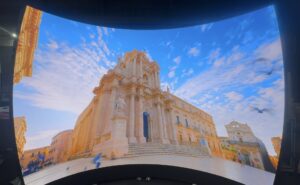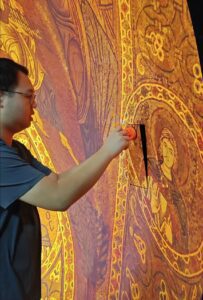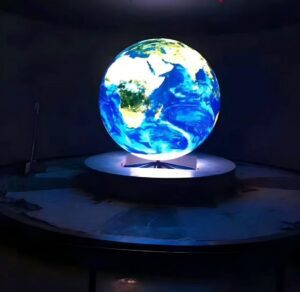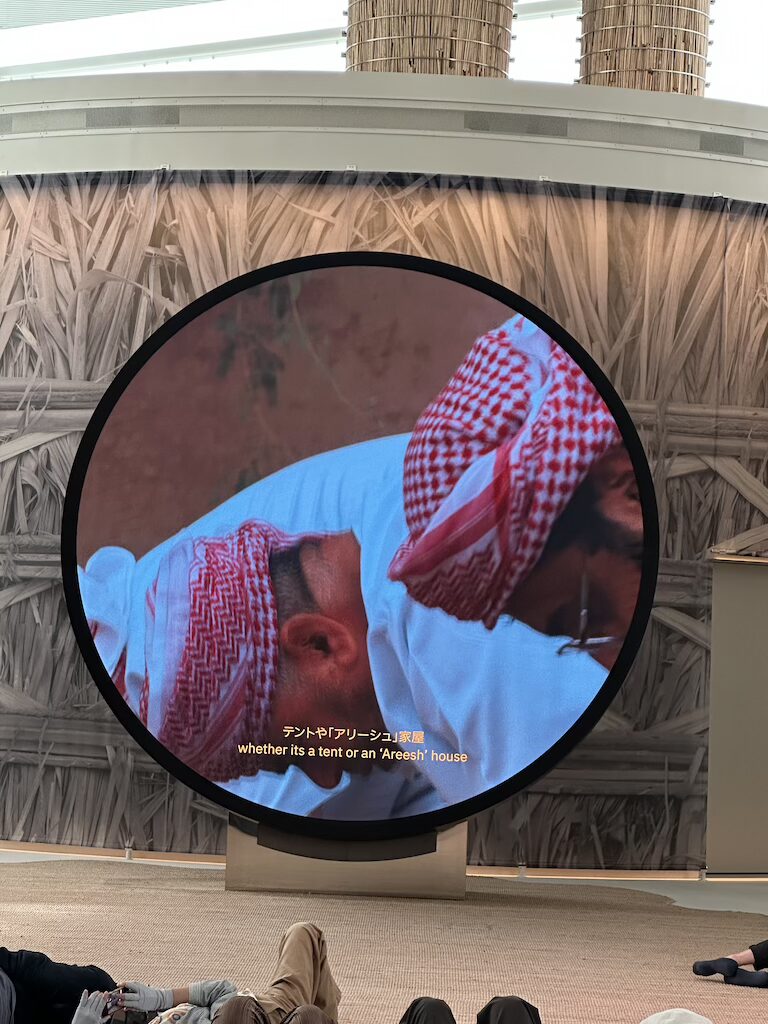
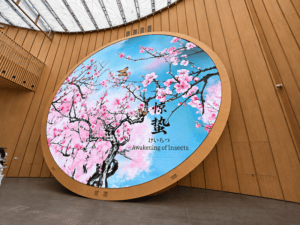
A circular LED display turns a part of the store that shoppers normally ignore — a column, a ceiling feature, a blank wall — into the thing they remember. Unlike a rectangular screen, a circle has no edges to hide and no “back” to turn away from: it reads from every approach route, holds a logo or a campaign in a shape the eye notices first, and works as a sign, a sculpture and a screen at the same time. Durway’s Panora round LED screen comes in four diameters — 480, 960, 1,440 and 1,920 mm — with a 2.5 mm pixel pitch, a GOB-protected surface and 360-degree viewing, built for exactly that job.
Why Does a Circle Work in Retail?
A shopping mall is a competition for attention, and a rectangle is the shape every screen already has. A circular display breaks that pattern in three ways.
First, it is noticed. The human eye is drawn to shapes that do not match their surroundings, and a glowing circle in a corridor of rectangles stops a shopper’s gaze for a second longer. That second is the difference between a display that is passed and a display that is read.
Second, it is read from every side. A flat screen has one viewing direction; a shopper approaching from the side sees an edge. A round display presents the same image to every approach route, which is what a column, a ceiling ring or a centre-court feature needs — shoppers arrive from all directions, and the display has to work for all of them.
Third, it is a landmark. Shoppers navigate malls by features — “meet me by the big circle” — and a circular display gives a store or a mall a meeting point that a rectangular screen never becomes. The display stops being advertising and starts being part of the place.
Where Does a Circular Display Go in a Store?
The placement decides the size, the content and the mounting. Four retail placements cover almost every project, and each one asks a different question.
| Placement | What it does | Best Panora size | The question to answer first |
|---|---|---|---|
| Column wrap or column face | Turns a structural pillar into a brand surface | 480 or 960 mm, one or more faces | How close do shoppers stand, and from which directions do they approach? |
| Ceiling feature or ring | Hangs overhead as a light and information feature | 960 or 1,440 mm, suspended | What is the ceiling height, and what holds the weight? |
| Wall feature | A circular brand mark on a flat wall, visible down a corridor | 960 or 1,920 mm, wall-mounted | How far away is the first viewing point? |
| Centre court or atrium | The landmark of the whole mall, read from every floor | 1,440 or 1,920 mm, suspended or floor-standing | What is the viewing distance from the farthest approach route? |
A column is the most common retail placement, because every mall has columns and most of them are wasted space. A circular display on a column face turns a structural obstacle into a brand surface, and shoppers standing a few metres away see a complete image rather than the edge of a flat panel. A ceiling ring works differently: it is read from below and from a distance, so it carries a logo, a short message or a slow-moving visual rather than dense text. A wall feature works down a corridor, where the circle reads as a sign long before the shopper reaches the store. A centre-court display is the biggest commitment and the biggest return — a landmark the whole mall navigates by.
Which Panora Size Fits Your Retail Space?
Panora comes in four diameters, and the choice is a viewing-distance decision, not a budget decision. All four share the same pixel pitch, surface and viewing angles; only the diameter changes.
| Model | Diameter | Pixel pitch | Brightness | Best viewing distance | Typical retail use |
|---|---|---|---|---|---|
| Panora 480 | 480 mm | 2.5 mm | 600–800 nits | Close range | Column face, boutique feature, product stand |
| Panora 960 | 960 mm | 2.5 mm | 600–800 nits | Short to medium range | Column feature, wall mark, reception feature |
| Panora 1,440 | 1,440 mm | 2.5 mm | 600–800 nits | Medium range | Ceiling ring, atrium feature, mall corridor |
| Panora 1,920 | 1,920 mm | 2.5 mm | 600–800 nits | Long range | Centre court, flagship lobby, exhibition hall |
All four models share the same core specification: SMD1010 Black LEDs, a 2.5 mm pixel pitch, a GOB-protected surface, front maintenance, 160-degree horizontal and vertical viewing angles, 5,000:1 contrast and a colour gamut of greater than 99% DCI-P3. The best viewing distance is 7.62 m. Durability is 5–8 years, with a typical warranty of 2–3 years, extendable.
Two details matter for retail. The GOB surface protects the LEDs against knocks, dust and moisture — a display at shopper height in a busy mall is touched, bumped and cleaned far more often than a wall screen in a boardroom. And front maintenance means a module is reached and replaced from the viewing side, without taking the display off the column or the ceiling. In a retail space that cannot close for a day, that is the difference between a ten-minute swap and a lost trading day.
What Content Works on a Circle?
A circle is not a rectangle with the corners cut off. Content made for a 16:9 screen looks wrong on a round display — text runs off the curved edge, logos are cropped, and the composition fights the shape. Three rules keep circular content working.
Design for the shape, not against it. Logos, product shots and short messages sit naturally in a circle. Wide landscape video and dense text do not. The strongest circular content is a single idea per loop: a product, a price-free brand mark, a seasonal message, a short animation that reads in a few seconds.
Keep text short and central. A shopper reads a circular display while walking. A headline of a few words, centred, with the detail kept off the screen entirely, works. A paragraph does not. If the message needs more words, it belongs on a flat screen nearby — the circle is the hook, not the brochure.
Use motion sparingly. A slow rotation, a gentle pulse, a product turning in space — motion that suits a circle. Fast cuts and flashing transitions fight the shape and tire the eye. The display should feel calm enough to stand next to and bright enough to notice from across the hall.
How Does a Circular Display Compare With a Flat Retail Screen?
The honest comparison is not “which is better” but “which job is it doing?”
| Decision point | Flat retail screen | Circular LED display |
|---|---|---|
| Viewing directions | One — shoppers must face it | Every direction — shoppers read it from any approach route |
| Role in the space | A screen on a wall | A landmark and a meeting point |
| Content strength | Long messages, video, price lists | Logos, product images, short campaigns |
| Placement | Needs a flat wall | Turns columns, ceilings and open space into display surfaces |
| Noticeability | Competes with every other rectangle | Stands out by shape alone |
| Cost of change | Swap the content file | Swap the content file — the shape is the investment |
A flat screen is the right tool for a menu board, a price list or a long product film. A circular display is the right tool when the job is to be noticed, to mark a place, and to carry a brand image that shoppers remember after they leave. Most retail projects use both: the circle brings shoppers to the store, and the flat screens inside do the selling.
Step-by-Step Checklist: From Column to Landmark
- Walk the shopper’s route. Stand at every entrance and approach route and mark where the eye lands. The display goes where shoppers already look, not where a free wall happens to be.
- Pick the placement first, the size second. Column, ceiling, wall or centre court — the placement fixes the viewing distance, and the viewing distance fixes the diameter. A 480 mm circle on a centre-court column is invisible; a 1,920 mm circle on a boutique column is overwhelming.
- Confirm the structure. A suspended ceiling ring needs fixing points engineered for its weight; a column face needs a mounting that follows the column’s shape. Bring the structure into the drawing stage, not after the display arrives.
- Decide the content before the order. Who makes the circular content, in what format, and how often does it change? A display with no content plan becomes a static logo within a month.
- Check the power and the control. Confirm the power supply route and the control connection before installation day. The client supplies the video content, the media server and the technical staff — those items are named in the project scope, not assumed.
- Plan the maintenance. Magnetic tiles and front access keep the display serviceable from the viewing side. Confirm who holds spare modules and how fast a failed tile is swapped.
- Test it at full brightness in the real light. A mall atrium at midday is bright. Check the display at 600–800 nits in the actual space, not in a dark showroom.
Frequently Asked Questions
What is a circular LED display?
A round LED screen — a flat, circular video surface built from LED modules — used as a brand feature, a sign or a landmark in retail, exhibition and architectural spaces. Panora is Durway’s circular LED screen, in diameters of 480, 960, 1,440 and 1,920 mm.
Why choose a round screen over a rectangular one in retail?
A circle is read from every approach route, stands out among rectangular screens, and works as a landmark shoppers navigate by. A rectangle is better for long messages and video; a circle is better for being noticed and remembered.
What sizes does Panora come in?
Four diameters: 480, 960, 1,440 and 1,920 mm. All four share a 2.5 mm pixel pitch, a GOB surface, 160-degree viewing angles and 600–800 nits of brightness. The size is chosen by viewing distance.
Can a circular display be mounted on a column?
Yes. Panora’s slim, lightweight, modular design suits column faces, corners and other creative shapes, with magnetic mounting and front maintenance. The mounting is designed for the column’s shape and confirmed per project.
How is a round LED screen maintained?
By front maintenance: magnetic tiles are removed and replaced from the viewing side, without taking the display off its mounting. Durability is 5–8 years, with a typical warranty of 2–3 years, extendable.
What content works best on a circular display?
A single idea per loop — a logo, a product image, a short seasonal message, a slow animation. Text should be short and central; dense text and wide landscape video belong on a flat screen.
Is the surface protected against knocks and dust?
Yes. The GOB surface treatment protects the LEDs against knocks, dust and moisture, which matters for a display at shopper height in a busy retail space.
Make the Building Work for the Brand
A retail space already has columns, ceilings and walls. A circular LED display does not add a screen to that space — it turns the space itself into the screen. Pick the placement by walking the shopper’s route, pick the size by the viewing distance, design the content for the circle, and plan the structure and the maintenance before the order is placed. The display that results is not just advertising. It is the landmark shoppers remember, and the meeting point they come back to.
For the full picture of what a round screen is and how the four sizes compare, see our guide to what a round LED screen is. For the questions buyers ask after choosing a size, see our round LED screen FAQ. And for the same landmark logic at building scale, see the small LED sphere display guide.
We turn clients’ concepts into reality. For specifications, quotations and project advice, contact Durway at info@durway.com.