In short:
A small LED sphere display is a spherical LED screen in the compact size class — up to about 3 metres in diameter — that shows moving content on every side at once. It works as a landmark, a wayfinding anchor and an exhibit in spaces where a flat wall would be walked past. Durway builds every LED sphere as a custom project: there are no standard models and no catalogue specifications, because the diameter, pixel pitch and brightness are engineered for the space, the viewing distances and the content, and are confirmed in the project proposal.

What is a small LED sphere display?
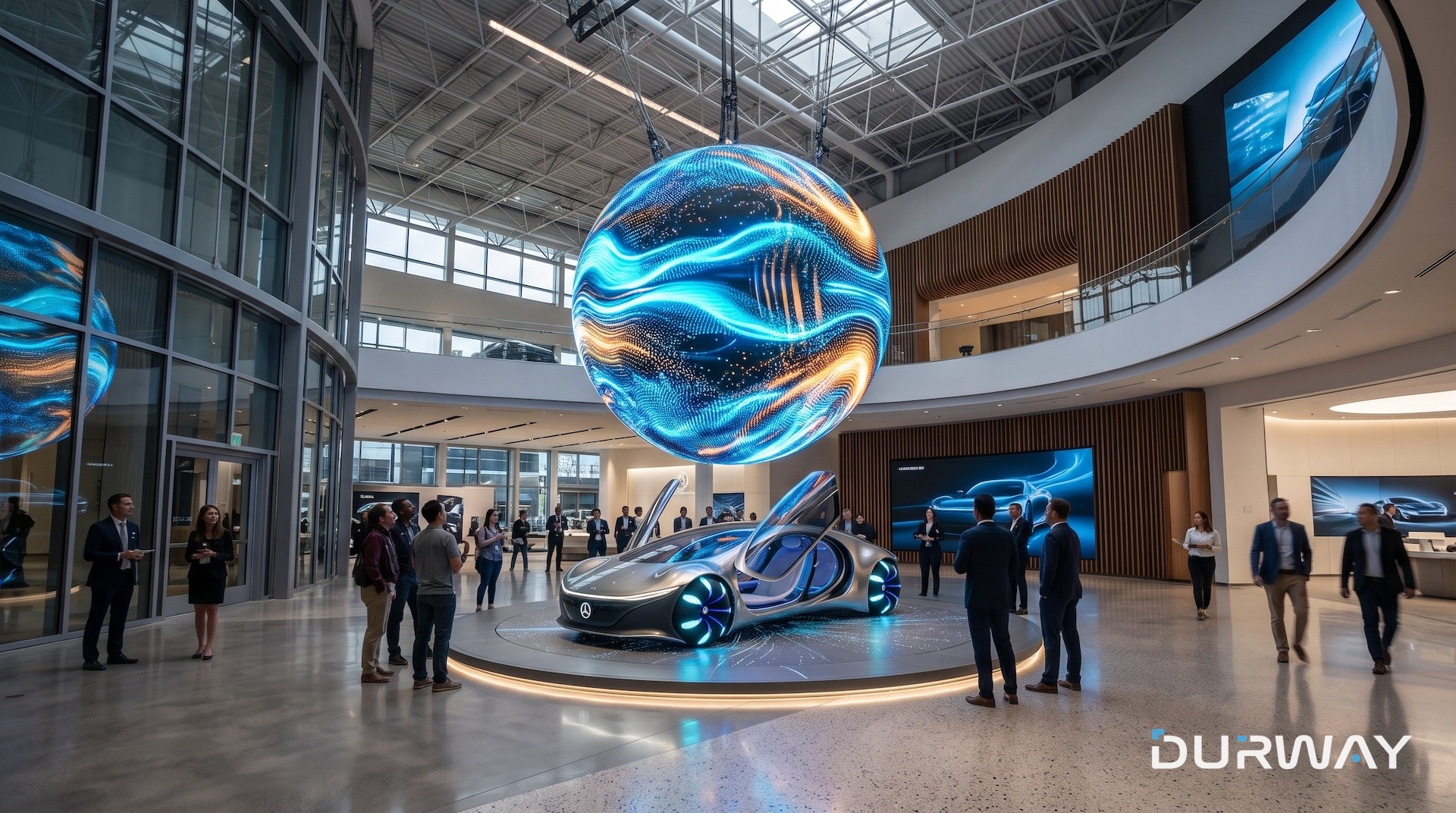
A small LED sphere display is a ball-shaped screen assembled from LED panels fitted to a spherical support structure, so the image wraps the full 360 degrees of the surface with no front, no back and no dead angle. In this size class — spheres up to roughly 3 metres across — the sphere is a piece of furniture-scale architecture: large enough to anchor a room and be read from across it, small enough to hang above a floor, stand in a lobby or sit inside an exhibition stand without rebuilding the space around it.
The size class matters because it changes how the screen is used. A sphere of this scale is viewed close up and from all sides at once, by people walking around it rather than sitting in front of it. That is a different design problem from a video wall, and it is why Durway treats every sphere as a one-off: the panel layout follows the exact diameter, and the specification is worked out from the buyer’s floor plan rather than picked from a model list.
Durway’s sphere work is not limited to this size class. For the Legacy Center in San Diego, Durway built a sphere 28 feet in diameter, with 10K horizontal resolution, a 2.5 mm pixel pitch and 1,500 nits of brightness — parameters set for that project. A compact sphere is engineered the same way, at the scale of a single room.
Why does a sphere work where a flat wall doesn’t?
It is visible from everywhere. A flat screen addresses one direction; everyone behind it or beside it sees a cabinet. A sphere addresses the whole room. In a retail floor, an exhibition hall or a lobby with traffic flowing past on several sides, the same content works for every approach route without turning the screen or duplicating it.
It becomes the landmark. People navigate by memorable objects, and a glowing sphere is one. Retailers and venues use compact spheres as the point visitors photograph, meet at and describe to others — “next to the globe” is wayfinding that no wall sign achieves. For brand spaces, the shape itself carries the message before any content plays: a planet, a product, a logo rendered as an object rather than a rectangle.
It fits the floor you already have. A sphere occupies a round footprint or hangs in unused airspace above it. Suspended over a circulation area or standing in an atrium corner, it adds a major visual feature without consuming wall length or blocking sightlines the way a large flat installation does.
It pulls footfall in retail. In a flagship store or shopping centre, a compact sphere is the feature shoppers see from every floor and every entrance — a rotating globe above the atrium, a product rendered as a floating object, a campaign visual that changes with each season and sale. Because it reads from all sides at once, one installation does the work of several wall screens, and it gives the centre a fixed point that visitors use to orient themselves and arrange to meet.
It stops traffic at exhibitions. On a trade-show stand or in a brand exhibition space, a sphere is visible above the neighbouring stands and readable from every aisle — a planet, a product world, a logo in the round. It marks the stand’s position across the hall, draws visitors in from a distance, and once they arrive it gives the stand a centrepiece that presentations and conversations gather around. After the show, the same sphere can move to the next event or into the brand’s own showroom.
It teaches in museums and science centres. A sphere is the natural shape for the exhibits these venues run: the Earth with its weather systems and ocean currents, the Moon, the planets, the Sun. Visitors walk around it, point at it and read it from every side, which makes it a gathering point for guided tours and school groups. The content can be switched between exhibits and updated as new data and stories are added, so one installation serves the venue for years of programming.
It signs the space in hotels and corporate lobbies. In a hotel lobby or a company headquarters, the sphere is the object the space is remembered by: a globe in the atrium, a moon above the reception desk, a brand mark rendered as a sculpture of light. Guests and clients photograph it, meet beside it and use it to give directions — and because the content is changeable, the same piece can welcome a conference, mark a festival or carry the brand’s current campaign.
It sets the mood in hospitality and nightlife. In a restaurant, bar or club, the sphere is both lighting and content: a slowly turning globe, a moon, a branded animation or ambient visuals that shift with the evening — dinner service, drinks, then late night. Hung above a bar or set into the centre of a dining room, it gives the venue a signature object guests recognise from the street and photograph once inside, and the content can change with the menu, the season or the event without touching the room itself.
It draws crowds in theme parks and visitor attractions. In a theme park, scenic area or visitor attraction, a glowing sphere is a photo point and a meeting point in one: a rotating planet at the entrance plaza, a moon over an evening parade route, or a branded globe at the heart of a themed land. It works through the day as a landmark and after dark as a light feature, and its content can follow the park’s seasons and festivals — Halloween, Christmas, a summer night show — without rebuilding the set around it.
It anchors events and banquets. For a wedding, a gala dinner, a product launch or an awards night, a sphere gives the room a centrepiece that works from every table and every camera angle — the couple’s monogram, the brand’s globe, a moon for the evening’s theme. It can hang above the dance floor or stand beside the stage, and its content follows the programme: welcome visuals on arrival, ambient scenes through dinner, the night’s branding for the awards and the party.

Which decisions define a small LED sphere?
Because there is no standard model, specifying a sphere means making a set of project decisions in the right order. The table below is the decision list Durway works through with buyers; the answers come from the site and the content, not from a catalogue.
| Decision | Options | What it affects |
|---|---|---|
| Finished diameter | Sized to the space, within this compact class (up to about 3 m) or beyond it | Panel layout, structure design, transport and installation route |
| Placement and mounting | Suspended from the ceiling structure; floor-standing on a base; integrated into an exhibit or feature build | Support structure, load calculations, ceiling or floor preparation |
| Environment | Indoor system; outdoor system | Panel protection, brightness engineering, structure and sealing |
| Viewing distance and pixel pitch | Pitch selected per project, from the closest and typical viewing distances | Image quality at close range, panel layout, total resolution |
| Brightness and ambient light | Engineered per project for the lighting of the space | Visibility under atrium daylight or in a darkened exhibit hall |
| Content format | Globe and planet visuals; brand motion graphics; data and ambient content | Content production method, playback system, update workflow |
| Audio | Silent operation; integrated audio as part of the system | Whether the sphere is a visual landmark only or a full exhibit with sound |
| Maintenance access | Planned service access to panels and internal systems | Structure design, spare-parts list, long-term service cost |
Two of these decisions drive most of the engineering. The first is diameter against viewing distance: a sphere that visitors can walk up to and touch needs its image engineered for arm’s-length viewing, while one suspended high in an atrium is read from metres away. The second is mounting, because a suspended sphere puts its load into the ceiling structure and a floor-standing sphere puts it into a base — and that choice has to be settled before the structure is designed.
How does viewing distance shape the specification?
On a sphere, viewing distance is not one number. The same visitor sees the near side of the ball from a step away and the far side across the room, and people approach from every direction. The specification therefore starts from the closest point at which someone will stand and study the surface, and the pixel pitch is selected for that distance as part of the project design.
This is why Durway does not publish a standard pitch for its spheres: the right pitch for a lobby globe that guests walk around is different from the right pitch for a sphere suspended above an exhibition stand, even at the same diameter. State the closest and typical viewing distances in the enquiry, and the pitch, the resulting resolution and the panel layout are confirmed against them in the proposal — before production, not after installation.
What does a complete LED sphere system include?
The visible ball is only one part of the delivery. A complete Durway sphere system is composed of six elements: the LED panels fitted to the spherical surface; the support structure that holds the sphere’s shape and carries its load, whether suspended or standing; the control system that drives the image; the power supply; the cooling system that manages heat inside a closed spherical form; and the audio system, where the project calls for sound.
Colour performance is specified at company level as greater than 99% of the DCI-P3 gamut. On durability, these systems are built from long-life, low-power materials for typically 5–8 years of reliable operation, with warranty terms typically of 2–5 years agreed per project. When comparing proposals, buyers should check that all six elements are actually included — a quotation for panels alone is not a quotation for a working sphere.

How is content produced for a spherical canvas?
A sphere is not a rectangle, and content has to be made — or adapted — for the curve. Video is mapped around the ball so that it meets itself seamlessly at the back, and designers work with the understanding that the image is compressed toward the poles and read in the round: a globe’s continents, a planet’s surface, a brand animation or a data visualisation all need to be laid out for that geometry, then previewed on the sphere’s actual layout before the launch date.
In practice, the content conversation belongs at the specification stage, alongside diameter and pitch. Tell the supplier what will play — existing brand assets, a commissioned globe, live or regularly updated content — and the playback and control side of the system is designed around it. Content that is only considered after the sphere is built is the most common cause of a delayed opening.
How is a small LED sphere installed and maintained?
Installation is planned around access: how the sphere reaches its position, whether it is assembled in place, and what the ceiling or floor structure must be prepared to carry. A suspended sphere is rigged to the building structure above a finished floor; a floor-standing sphere is built up on its base. In both cases the route in, the assembly space and the load path are surveyed before production, because a sphere cannot be improvised into position.
Maintenance is designed in at the same stage. The structure and panel layout must leave a workable way to reach panels and the internal systems — power, cooling and control — for inspection and service over the system’s life. Agree the access method and the spare-parts list when the structure is designed; on a closed spherical form, both are difficult and expensive to retrofit.

How to specify a small LED sphere display, step by step
Step 1 — Send the space, not just the size. Provide the floor plan or photographs of the intended position, the ceiling height and the available footprint, and state whether the sphere will be suspended or floor-standing. The space defines the diameter range that makes sense.
Step 2 — Fix the diameter and mounting. Agree the finished diameter within the space and settle the mounting: ceiling structure and load for a suspended sphere, base and floor load for a standing one. Confirm who prepares the building structure.
Step 3 — Set the viewing distances. Record the closest point a viewer can reach and the typical distances around the room, and state whether the system is indoor or outdoor. The pixel pitch and brightness are engineered from these and confirmed in the proposal.
Step 4 — Define the content. Describe what will play on the sphere and how often it changes. Confirm who produces the spherical content and that it will be previewed on the final layout before launch.
Step 5 — Confirm the full system and the service plan. Check that the proposal covers all six system elements — panels, structure, control, power, cooling and audio where required — plus installation, the maintenance access method, spare parts and the warranty term.

Frequently asked questions
Are there standard sizes or models for LED spheres?
No. Durway builds every LED sphere as a custom project, so there is no standard model list. Spheres up to about 3 metres form the compact class covered in this guide, and the exact diameter is set by the space and confirmed in the proposal.
What pixel pitch and brightness will my sphere have?
Both are engineered per project, from the viewing distances, the diameter and the ambient light of the space, and are stated in the project proposal rather than published as standard figures. Send the room details with your enquiry and the specification is worked out from them.
Can a small LED sphere be used outdoors?
Yes — Durway builds both indoor and outdoor dome and sphere systems. An outdoor specification changes the panel protection, the brightness engineering and the structure, so the environment must be stated at enquiry stage.
How long does an LED sphere last, and what warranty applies?
These systems are built for typically 5–8 years of reliable operation. Warranty terms are agreed per project and are typically 2–5 years; confirm the term and what it covers in the proposal.
Can a sphere hang from the ceiling?
Yes, suspended mounting is one of the standard arrangements for this size class, provided the ceiling structure can carry the load. The alternative is a floor-standing base. The mounting decision is made at specification stage because it drives the structure design.
What does Durway need from me to prepare a proposal?
The position and dimensions of the space (a floor plan or photographs are enough to start), the intended mounting, the closest and typical viewing distances, whether the site is indoors or outdoors, and a description of the content you want to show. From those, Durway confirms the diameter, pitch, brightness and a full system proposal.
Start with the space
Every sphere project begins with the room it has to anchor. Send Durway your floor plan or photographs of the position — with a note of how close visitors will stand — and the team will confirm the diameter, the mounting, the engineered specification and a custom proposal for the complete system.
Contact: info@durway.com · www.durway.com
We turn clients’ concepts into reality.