1. Conforming to Complex Ceiling Geometries
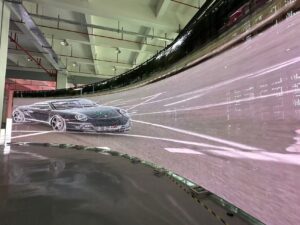
To perfectly fit an LED screen to a highly irregular ceiling, the integration process must begin long before the first module is installed. It requires a transition from traditional flat-panel construction to a custom-engineered spatial framework.
- 3D Point Cloud Scanning: The physical architectural space is first mapped using precise laser scanning. This creates a digital twin of the ceiling’s high-low drops and curves.
- Flexible PCBs: Instead of rigid fiberglass boards, engineers use flexible Printed Circuit Boards (PCBs) that can bend along a single axis to follow sweeping arches or rolling waves.
- Bespoke Sub-frames: The LED mounting frame is custom-manufactured (often using CNC-machined aluminum or 3D-printed nodes) to perfectly mirror the ceiling’s contours, acting as an exact bridge between the raw building structure and the display surface.
2. Why Standard Modules Fail on Multi-Axis Curves
Standard LED modules are mass-produced, rigid, and strictly rectangular (often 250x250mm or similar). When architecture introduces height drops and multi-axis (compound) curves—like a dome or a twisting ribbon—standard modules cannot physically adapt.
| Feature | Standard Rectangular Modules | Custom/Flexible Modules |
|---|---|---|
| Compound Curves | Creates a faceted, “disco ball” effect with rigid polygonal edges. | Bends smoothly to maintain a continuous radius. |
| Module Seams | Leaves V-shaped gaps when forced to bend along multiple axes. | Interlocks seamlessly, utilizing custom geometric shapes. |
| Height Drops | Cannot accommodate sudden topographical changes without exposed edges. | Can be manufactured in varying sizes to bridge topographical drops perfectly. |
3. Making LED an Inherent Architectural Element
The goal of structural integration is for the audience to ask, “Is that a ceiling or a screen?” Achieving this illusion requires treating the LED not as A/V equipment, but as a primary building material.
- Flush Integration: The screen must be installed within a recessed architectural cavity rather than surface-mounted. The edges of the LED modules should perfectly meet the surrounding drywall, metal, or wood without raised bezels.
- Material Camouflage: By applying specific anti-glare masks or custom louver designs, the screen can be engineered to mimic the color and texture of the surrounding ceiling when powered off, preventing the dreaded “black hole” effect on the ceiling.
- Zero-Edge Design: Designing the structural border so that the active pixels reach the absolute edge of the physical architecture, leaving zero dead space between the screen and the building.
4. The Art of Invisibility: Hiding the Hardware
A true architectural integration means zero visible infrastructure. Brackets, power supplies, and signal cables must vanish entirely.
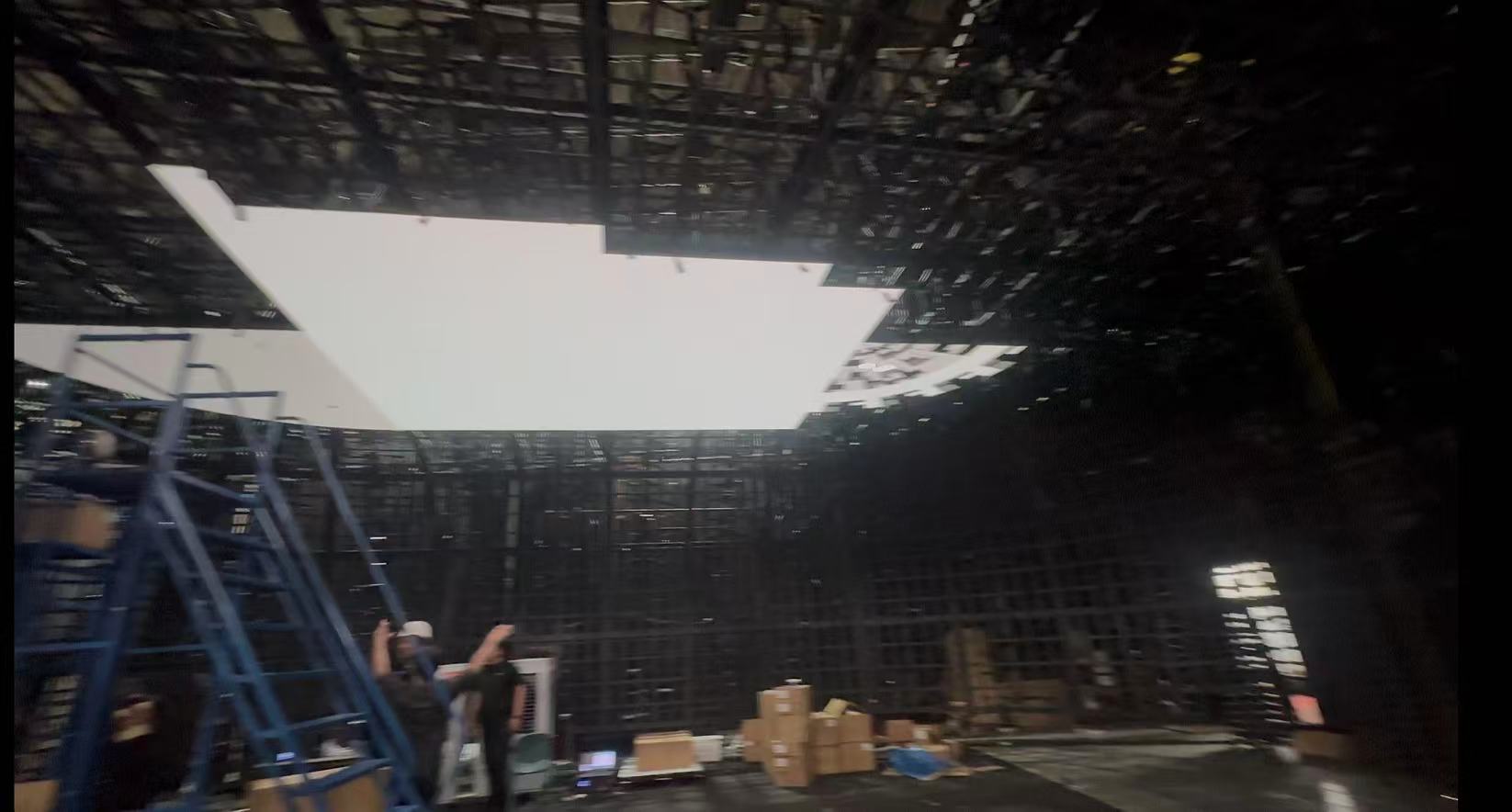
- Concealed Spatial Frames: The mounting brackets are moved entirely behind the display plane. Using a custom space-frame hidden within the ceiling plenum allows the modules to snap into place magnetically from the front.
- Remote Power and Data: Heavy power supply units (PSUs) and sending cards generate heat and require bulky wiring. By moving these components to a remote server room, only low-voltage DC cables and fiber optics need to be routed to the ceiling, drastically reducing bulk.
- Blind-Mate Connectors: Modules are designed with hub-boards that feature pin-to-pin connectors. When the module is pushed into its magnetic slot, power and data connect automatically without the need for manual, visible wire daisy-chaining.
Case Study: The 100+ Custom Module Immersive Ceiling
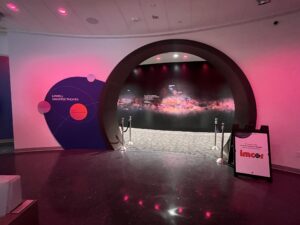
The ultimate proof of architectural integration is seen in a recent project featuring an immersive, multi-dimensional ceiling canopy. The architecture called for sweeping organic waves, sudden topographical height drops, and a continuous flow that wrapped around structural pillars.
Using standard square modules would have resulted in hundreds of visible seams and sharp, jagged transitions. To achieve a perfectly fluid digital skin, the engineering team abandoned standard sizing entirely.
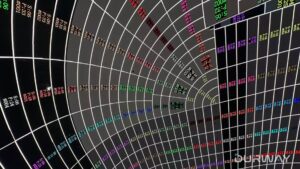
They designed and manufactured over 100 distinct types of custom LED modules. This included varying sizes of trapezoids, triangles, and uniquely curved flexible strips. Like a massive, precision-engineered jigsaw puzzle, these 100+ unique shapes interlocked to absorb the multi-axis curves and height drops natively. Paired with a concealed, 3D-modeled skeleton and remote power routing, the final result was a completely seamless digital sky that felt poured into the architecture rather than hung beneath it.
Frequently Asked Questions
1. How do you install LED displays on curved architectural ceilings?
2. Why can’t standard LED modules be used for complex ceiling drops and domes?
3. How are cables and power supplies hidden in architectural LED integrations?
4. How do you maintain an LED ceiling if the hardware is completely built into the architecture?