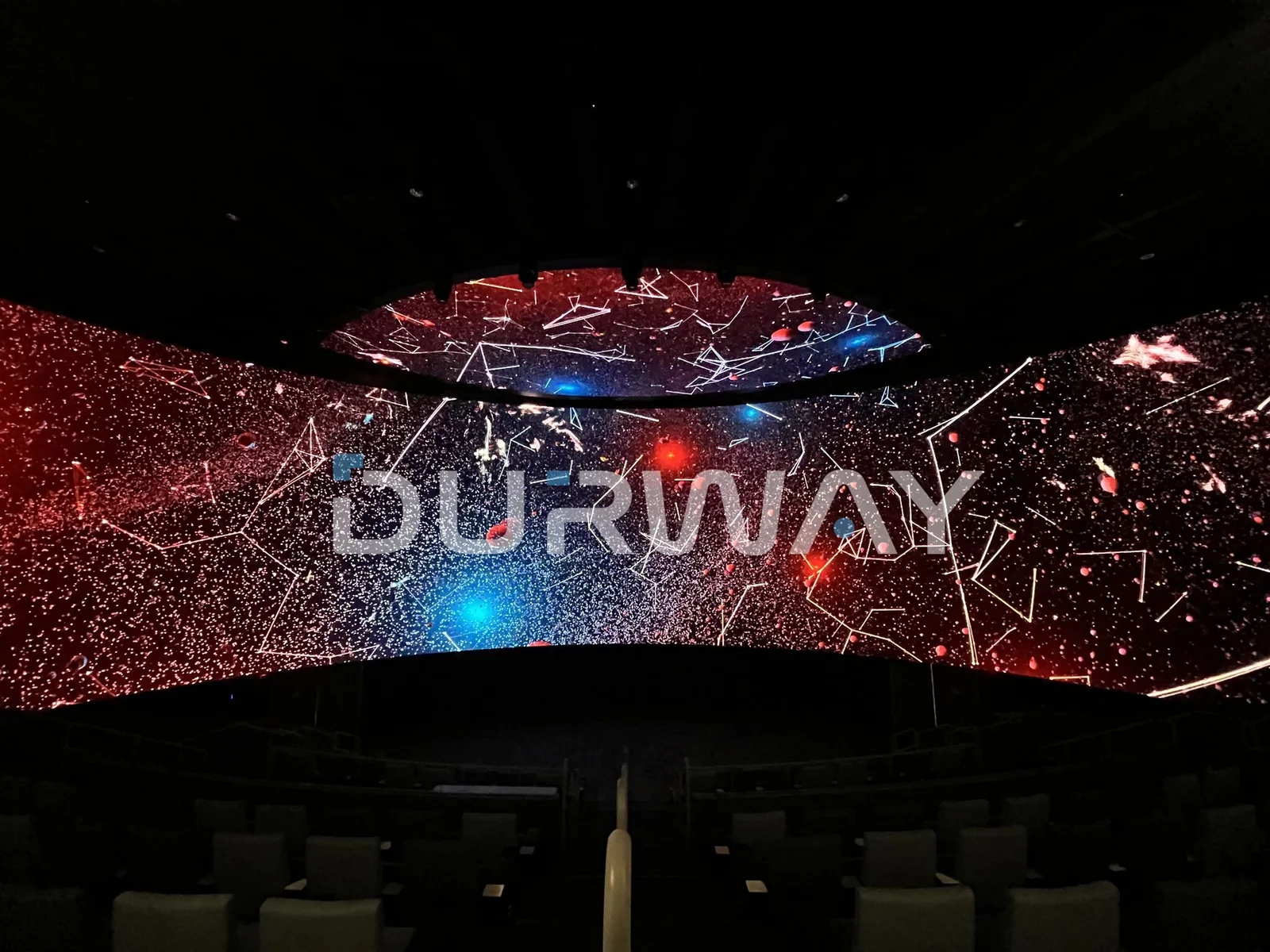
When Lowell Astronomy Theater in Flagstaff, Arizona, needed a screen that could show the night sky and let the sound come from behind the picture at the same time, the answer was a 1.9 mm acoustic transparent LED screen. Built with Skyskan, the EchoFlex installation puts the loudspeakers behind the display instead of beside it, so the narration and the music appear to come from the stars themselves. This case study walks through the problem, the screen that was chosen, the six parts of the system, and the checklist any astronomy theater can use before specifying the same kind of wall.
What Problem Was the Theater Trying to Solve?
An astronomy theater has a problem that a cinema or a conference room does not have. The audience sits in the dark, looking up and around, and the sound has to feel as if it comes from the sky — not from a speaker box bolted to the side wall. In a traditional setup, the picture and the sound live in two different places: the image is on the screen in front, and the speakers sit off to the sides or above, because a solid screen blocks sound. The audience hears the narrator from the left while watching a star field straight ahead, and the illusion quietly breaks.
A perforated projection screen is the old answer to that problem: tiny holes let some sound through. But a projection screen brings its own compromises — the room has to stay dark, the image washes out under any ambient light, and the projector’s black is never really black, which matters when the subject is the night sky. Lowell wanted the brightness and the true black of direct-view LED, and it wanted the sound to pass through the screen itself.
That is the decision an acoustic transparent LED screen exists for. The screen is built from LED tiles with open space between the light-emitting points, so sound passes through the display surface while the picture stays bright, sharp and seamless. The speakers sit behind the wall, invisible, and the sound arrives from the same direction as the image.
Why 1.9 mm? The Model Choice in One Table
EchoFlex comes in three models, and the choice between them is a viewing-distance decision first and an acoustic decision second. The finer the pitch, the closer the audience can sit without seeing the pixel grid — and the smaller the open area between pixels. Lowell chose the middle model, and the table below shows why that balance fits an astronomy theater.
| Model | Pixel pitch | Module resolution | Pixel density | Module weight | Best fit |
|---|---|---|---|---|---|
| EFP1.5 | 1.5625 mm | 256 × 192 | 409,600 /m² | 1.56 kg | Closest seating, finest detail |
| EFP1.9 | 1.923 mm | 208 × 156 | 270,422 /m² | 1.45 kg | Theater seating at a few metres — the Lowell choice |
| EFP2.5 | 2.5 mm | 208 × 156 | 160,000 /m² | 1.45 kg | Longer viewing distance, most open area |
All three models share the same platform: 400 × 300 mm tiles, a 600 mm curvature radius for curved walls, 600 nits calibrated brightness, a 5000:1 contrast ratio, a 160° horizontal and vertical viewing angle, 16-bit grayscale, a 1,920–3,840 Hz refresh rate and frame rates of 59.94, 60 and 120 Hz. Colour temperature adjusts from 2600 K to 9500 K, and the colour gamut is >99% DCI-P3. The screen is rated IP30 for indoor use, with a 100,000-hour LED lifetime at 50% brightness and a 5–8 year durability rating.
Two numbers in the table deserve a careful reading. First, the open-area ratio — the share of the screen surface that sound can pass through — is highest on the 2.5 mm model, at 18–20%. That figure belongs to the 2.5 mm model only; the finer models have less open area, and no figure is published for them. Second, the 600 nits brightness is a calibrated figure, measured after the screen is tuned for colour accuracy, not a peak figure quoted before calibration. For a dark theater showing star fields, calibrated brightness and true black matter more than a headline peak number.
For a fuller explanation of how sound passes through the display, see our guide to what an acoustic transparent LED screen is — and for the theater planning view, our guide to LED screens for planetariums and immersive theaters.
The Six Parts of the System
An acoustic LED screen is not a single product. It is a system of six parts, and the Lowell installation uses all six. Understanding the parts matters because each one is a separate decision in the project, and a supplier who quotes only the tiles is quoting half the job.
| Part | What it does | Lowell note |
|---|---|---|
| LED Tile | The picture surface — 400 × 300 mm modules, magnetically mounted | 1.9 mm pitch, curved to the theater wall |
| RV Box | Receives and distributes the video signal to the tiles | Sized to the wall’s tile count |
| Power line | Low-voltage remote power to the wall | Remote supply keeps high voltage away from the screen |
| Controller | Drives the image; NovaStar is the default | Other brands fitted per customer request |
| Power supply | Fanless PSU box for indoor use; waterproof option exists | Fanless — no fan noise in a quiet theater |
| Data line | Carries the signal between controller and tiles | Routed with the power lines behind the wall |
Three details in that list decide whether the installation works in a theater. The first is the fanless power supply: a theater audience sits in silence between narrations, and a humming fan would be audible. The second is low-voltage remote power, which keeps the screen itself safe to touch and service. The third is the controller: NovaStar is the default control system, with other brands fitted per customer request, and no controller model is promised before the project is scoped.

What the Audience Actually Experiences
The technical case for the screen is straightforward. The experiential case is the reason the theater chose it, and it comes down to three changes the audience can feel.
The sound comes from the picture. With the speakers behind the screen, a narrator describing a constellation appears to speak from the constellation itself, and music swells from the same direction as the nebula on screen. There is no left-right mismatch to remind the audience that they are watching a display.
The night sky is genuinely dark. A projected black is grey, because a projector cannot project darkness. An LED tile switched off is dark. In a show about the night sky, the difference between grey and black is the difference between a picture of space and the feeling of being under it.
The image holds up under the house lights. Between shows, during educational sessions, or when the theater runs a brighter program, the 600-nit calibrated brightness keeps the picture readable without plunging the room into total darkness. The theater does not have to choose between a good show and a usable room.
The Project Checklist: Six Steps Before You Specify
Lowell’s project followed the same sequence any astronomy theater or planetarium should follow. The steps are in order, and skipping one is how projects end up with a screen that fits the room but not the show.
- Define the show first. What will the screen display — fulldome astronomy, live-narrated star tours, pre-rendered films, educational programs? The content sets the brightness, the colour accuracy and the refresh rate the screen must hold.
- Measure the seating, not the wall. The nearest seat sets the pixel pitch. Work out the closest viewing distance, then choose the model whose pitch disappears at that distance. At Lowell, that calculation pointed to 1.9 mm.
- Place the speakers on the drawing. Decide the speaker positions behind the screen before the structure is built. The screen, the speaker mounts and the acoustic treatment behind the wall are one design, not three separate ones.
- Confirm the curve. If the wall curves, confirm the 600 mm curvature radius against the theater’s geometry. A curve tighter than the tile can follow needs a different module or a segmented design, and that decision belongs at drawing stage, not on site.
- Plan the power and the silence. Confirm the low-voltage remote power layout and the fanless power supply. In a quiet theater, the power design is part of the acoustic design.
- Name who supplies what. The client supplies the video content, the media server and the technical staff. Those items are named in the project scope at the start, so nothing is assumed on either side. Installation, training, custom service, annual inspection, 24/7 online support and after-sales repair are part of the supplier’s service.
For the installation side of this checklist in detail, see our guide to installing a curved acoustic LED screen.
How the Screen Is Serviced in a Working Theater
A theater screen earns its keep between shows as much as during them. The wall runs for hours every day, and the maintenance plan has to fit around a programming schedule, not the other way round. EchoFlex is built for that reality in three ways.
First, the tiles are magnetically mounted and removable from the front. A failed tile comes off the wall without dismantling the structure behind it — and in an acoustic theater, the space behind the wall is filled with speakers and acoustic treatment, so rear access is rarely an option. Front maintenance is not a convenience feature here; it is the only practical way to service the screen without disturbing the sound system.
Second, the screen is designed around a small spares holding. Because each tile is a standard 400 × 300 mm module, the theater keeps a handful of spare tiles and swaps a faulty one in minutes, rather than waiting for a part machined to a unique size. The replacement tile is calibrated to match its neighbours, so the swap is invisible to the audience.
Third, the service relationship continues after installation. The supplier’s service covers installation, customer training, custom service, annual inspection, 24/7 online support and after-sales repair, with a warranty that is typically 2–3 years free and extendable. For a venue that runs shows every day, the annual inspection is the moment when the screen, the power supplies and the signal chain are checked together, before a small problem becomes a cancelled show.
Acoustic Screen or Ordinary LED Wall?
Not every theater needs sound to pass through the screen. The table below is the honest way to decide.
| Decision point | Ordinary LED wall | Acoustic transparent LED screen |
|---|---|---|
| Speaker position | Beside or above the screen | Behind the screen, invisible |
| Sound-image alignment | Sound comes from the side | Sound comes from the picture |
| Room darkness | Works in a lit room | Works in a lit room |
| Black level | True black | True black |
| When to choose it | The sound system is separate and visible anyway | The audience must believe the sound comes from the scene |
If the speakers are already part of the architecture and the audience never notices them, an ordinary wall is the simpler purchase. If the show depends on the audience forgetting the room exists — a star field, a nebula, a flight through the solar system — the acoustic screen earns its place.
Frequently Asked Questions
What is an acoustic LED screen?
A direct-view LED display built from tiles with open space between the pixels, so sound passes through the screen surface. Speakers sit behind the display, and the audience hears the sound coming from the picture itself.
Why did Lowell choose the 1.9 mm model?
The 1.9 mm pitch (EFP1.9) balances fine detail for theater seating distances with the acoustic performance of the range. The finer 1.5625 mm model suits closer seating; the 2.5 mm model suits longer viewing distances and carries the highest open-area ratio in the range, at 18–20%.
Can the screen curve?
Yes. EchoFlex tiles bend to a 600 mm curvature radius, so the screen can follow concave, convex or flat theater walls. The curve is confirmed against the theater’s geometry at drawing stage.
How loud can the sound behind the screen be?
The speakers are standard theater loudspeakers mounted behind the wall; the screen does not set a volume limit. What the screen sets is how much of the sound reaches the audience undistorted, which is why the open-area ratio is specified per model rather than for the range as a whole.
Does the screen need rear access for maintenance?
EchoFlex supports both front and rear maintenance. Tiles are magnetically mounted and can be removed from the front, which matters in a theater where the space behind the wall is filled with speakers and acoustic treatment.
What control system does it use?
NovaStar is the default control system, with other brands fitted per customer request. No controller model is promised in advance.
Who supplies the content and the media server?
The client supplies the video content, the media server and the technical staff. Those items are named in the project scope at the start, so nothing is assumed on either side.
What is the warranty?
Typically 2–3 years free, extendable. The screen is rated for 5–8 years of service, with a 100,000-hour LED lifetime at 50% brightness.
What This Case Proves — and What It Does Not
One case study proves one thing well: that a 1.9 mm acoustic LED screen can carry a real astronomy theater’s shows, with the speakers hidden and the sound aligned to the picture. It does not prove that every theater should buy the same model. The pitch, the curve, the speaker layout and the power design all follow from the room, the seating and the show — which is why every EchoFlex wall is specified per project, not picked from a catalogue table.
The question to take into your own project is the one Lowell answered first: where should the sound come from? Answer that, measure the nearest seat, and the screen almost chooses itself.
We turn clients’ concepts into reality. For specifications, quotations and project advice, contact Durway at info@durway.com.