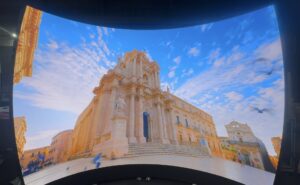
A flexible LED screen bends where a rigid cabinet cannot — around columns, along waves, over curved walls — because its modules are built on a bendable board with a soft silicone face and held in place by magnets. The three questions every buyer asks are the same: how tight can it bend, how does it stay on the wall, and how do you fix it when a module fails? This article answers all three, with the IFlexPro flexible LED screen range as the reference.
Which IFlexPro Model Fits Your Project?
IFlexPro is not one module. It is three module families, and the family sets the pitch, the module size and the weight — which is why the first step is always to match the family to the viewing distance and the shape.
| Module family | Pixel pitch | Module size | Module weight | Best fit |
|---|---|---|---|---|
| 400 × 300 mm | 2.5 / 3.125 mm | 400 × 300 × 7.6 mm | 1.15 / 1.25 kg | Large curves, columns, stage backdrops |
| 288 × 144 mm | 1.25 / 1.5625 / 1.875 mm | 288 × 144 mm | 0.4 kg | Fine-pitch curved walls, close viewing |
| 300 × 168.75 mm | 1.25 / 1.5625 / 1.875 mm | 300 × 168.75 mm | 0.5 kg | Fine-pitch curves with a 16:9 module |
All three families share the same platform: 800–1200 nits brightness, a 5000:1 contrast ratio, 160° viewing angle, 16-bit grayscale, a 1,920–3,840 Hz refresh rate, and colour temperature adjustable from 2600 K to 9500 K. The colour gamut is >99% DCI-P3. The screen is rated IP30 for indoor use, with a 100,000-hour LED lifetime at 50% brightness and a 5–8 year durability rating. Certifications are ETL, TUV-CE, FCC, CB, EAC and RoHS.
For the broadcast-studio side of flexible screens, see our guide to flexible LED displays for broadcast studios — and for the full buyer’s guide, our custom flexible LED display guide.
How Tight Can a Flexible LED Screen Bend?
Short answer: it depends on the module family and the steel frame it bends around — confirm the minimum bending diameter with your supplier before finalising the design.
A flexible module bends; the frame does not. The finished shape comes from a steel structure cut and rolled to the radius on your drawing, and the modules follow that structure. The bend is a property of the module and the frame together, not a single number on a datasheet.
Three rules follow. First, the tighter the curve, the smaller the module you want. Second, confirm the curve against the module family before production, not on site: if the radius on the drawing is tighter than the module can follow, the choice is a smaller module, a segmented appearance, or a different display technology. Third, the frame’s accuracy decides the picture quality. A flexible module conforms exactly to the structure underneath it, so any unevenness in the steel frame shows up as a visible seam or a dark line between modules.
How Does Magnetic Mounting Work?
IFlexPro modules attach to the steel frame with magnets — no screws through the front face, no brackets on the visible surface. The module is placed gently against the frame and the magnets pull it into position; if one corner sits higher than its neighbours, the module is lifted off and the mounting point adjusted, rather than pressed down hard. Forcing a module flat can damage the flexible board and its connections.
Magnetic mounting makes the screen seamless, because modules sit edge to edge with no visible fixings — and serviceable, because any single module can be removed from the front without touching its neighbours.
Front or Rear Maintenance: Which One Do You Need?
| Situation | Front maintenance | Rear maintenance |
|---|---|---|
| Screen wrapped around a column | Essential — there is no space behind | Not possible |
| Screen suspended overhead | Essential — no access from behind | Not possible |
| Screen on a wall with a service corridor | Works, and is usually faster | Works |
IFlexPro supports both front and rear maintenance, and the right choice is set by the installation, not by the product. A column wrap or a suspended screen leaves no room behind it, so front service is the only option. Decide this before the structure is built: a screen that needs rear access but is installed flat against a wall is a screen that cannot be repaired without dismantling it.
How Do You Replace a Single Module?
Replacing a module is a five-step job, the same whether the screen is flat or curved.
- Power down the section. Isolate the power to the affected area before touching the screen.
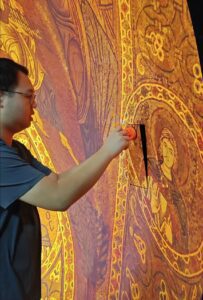
- Remove the module from the front. Use the suction-cup tool to lift the magnetic module straight off the frame. Do not pull it at an angle and do not force it.
- Disconnect the data and power. Unplug the module’s connectors and check them for damage before fitting the replacement.
- Fit the spare module. Place the replacement gently against the frame, let the magnets seat it, and check all four edges sit level with the surrounding modules.
- Re-calibrate and verify. Power the section back up and check the replacement tile’s brightness and colour against its neighbours. For the full installation procedure, see our guide to how flexible LED modules are installed.
Spares, Handling and Storage: The Short Checklist
- Hold spare modules. Keep a small stock of spares, including any corner or non-standard modules the design uses. A standard module can be swapped in minutes; a missing custom module stops the repair.
- Handle modules gently. Never fold a module sharply, never stack heavy objects on it, and never pull a magnetically mounted module violently off the frame.
- Store flat, dry and cool. Storage temperature is −40 °C to 60 °C and storage humidity 10%–90% RH.
- Keep power and signal reachable. Power supplies, receiving cards, hub boards and AC distribution must be accessible for service.
Frequently Asked Questions
What is the minimum bend radius?
It depends on the module family and the steel frame. Confirm the minimum bending diameter for your module family and your drawing’s radius with the supplier before production. If the curve is tighter than the module allows, use a smaller module or accept a segmented appearance.
Can a flexible LED screen be installed flat?
Yes. A flexible screen works flat, but for a flat wall a rigid cabinet screen is usually the more cost-effective choice.
How is a failed module replaced?
From the front, using a suction-cup tool to lift the magnetic module off the frame, then fitting a calibrated spare. No dismantling of the surrounding structure is needed. See the five-step procedure above.
What is the warranty and lifetime?
Typically 2–3 years free, extendable. The screen is rated for 5–8 years of service, with a 100,000-hour LED lifetime at 50% brightness.
What control system does it use?
NovaStar is the default control system, with other brands fitted per customer request. No controller model is promised in advance.
Who supplies the content and the media server?
The client supplies the video content, the media server and the technical staff. Those items are named in the project scope at the start, so nothing is assumed on either side.
Specify the Curve First
The mistake buyers make with flexible screens is starting with the pixel pitch. Start with the curve instead: the radius on the drawing, the module family that follows it, and whether the screen can be serviced from the front. Get those three right and the pitch, the brightness and the refresh rate fall into place.
We turn clients’ concepts into reality.
For specifications, quotations and project advice, contact Durway at info@durway.com.