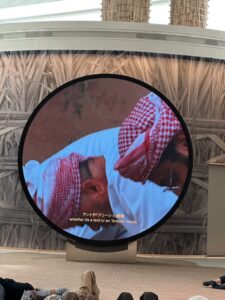
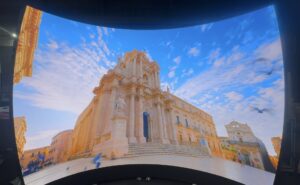
The LED sphere at the Legacy Center in San Diego is 28 feet across, runs at 10K horizontal resolution on a 2.5 mm pixel pitch, and shines at 1500 nits. Those four figures belong to one project — they are the measurements of this sphere, not a standard specification, because every LED sphere Durway builds is custom-made for its venue.
The Project in One Table
Every figure below is specific to the Legacy Center installation. It is labelled as a case figure throughout this article, and none of it should be read as a standard product specification.
| Item | Legacy Center sphere (case figures) |
|---|---|
| Diameter | 28 feet |
| Horizontal resolution | 10K |
| Pixel pitch | 2.5 mm |
| Brightness | 1500 nits |
| Form | Spherical LED display, custom-built for the venue |
Why a Sphere Instead of a Flat Wall?
A flat wall shows a picture to people facing it. A sphere does something a flat wall cannot do: it is visible from everywhere in the room at once, and it has no edge where the picture stops. Visitors walk around it and see a different face of the same image from every angle. For a museum or experience centre, that changes the display from a screen on a wall into an object in the space.
The trade-off is that a sphere is harder to build and to feed with content. The structure has to hold a curved LED skin true in three dimensions, the panels have to join seamlessly across a compound curve, and the image has to be mapped onto a ball rather than stretched across a rectangle. That is why spheres are custom-built per project: diameter, pitch, brightness and mounting are set by the venue, the viewing distances and the content, and confirmed on inquiry. For the dome-versus-sphere decision in full, see our guide to LED dome vs LED sphere.
How Big Should a Sphere Be? A Size-Class Guide
Spheres are built from desktop globes to building-scale installations, and the size class decides the viewing experience. Durway builds acoustic-transparent domes and spheres from 1 m to over 20 m in diameter, at pixel pitches from 1.5 mm — that is the available capability range, not a catalogue of standard sizes.
| Size class | What it is used for | How people watch it |
|---|---|---|
| Desktop to 1 m | Reception features, retail displays, exhibition centrepieces | Up close, within arm’s reach |
| 1–5 m | Museum galleries, lobbies, brand spaces | Walk-around viewing from a few metres |
| 5–10 m | Atriums, experience centres, large exhibitions | Viewed from across a hall, from several floors |
| 10 m and above | Landmark installations, such as the 28-foot Legacy Center sphere | Seen from everywhere in the venue, often from below |
The rule is simple: the bigger the sphere, the further away the audience stands, and the wider the pitch that still looks seamless. A small sphere viewed at arm’s length needs a fine pitch; a landmark sphere viewed from twenty metres does not.

What Plays Well on a Ball?
Content made for a flat screen looks wrong on a sphere. The image has to be designed for a ball from the start, and four rules decide whether it works.
Design for the equator, not the poles. The middle band of the sphere is where the audience looks. Put the subject — the Earth, a product, a face — on the equator, and keep the poles for background or sky.
One idea per rotation. A sphere shows many faces at once, so a single clear image reads better than a busy collage. Let the sphere rotate slowly and let the audience discover the image as it turns.
Slow movement beats fast cuts. Fast cuts are hard to follow when the screen wraps around the viewer. Slow rotations and gentle transitions suit the form.
Mind the seam between content and structure. Keep the important imagery clear of the point where the sphere meets its support.
For the full content guide, see our article on content for LED spheres.
The System Behind the Skin
A sphere is a system of six parts, designed together: LED panels, support structure, control system, power supply, cooling system and audio system. The support structure carries the whole weight of the skin and has to hold its shape to a tight tolerance — a structure that flexes shows up on screen as a visible distortion. Power and cooling are sized per project. For venue planning detail, see our guide to LED domes for science museums and planetariums. NovaStar is the default control system, with other brands fitted per customer request, and no controller model is promised in advance.
Spheres can also be built acoustic-transparent, so speakers can sit inside or behind the display and the sound appears to come from the sphere itself. The display is rated for 5–8 years of service, with a warranty that is typically 2–5 years, and the colour gamut is >99% DCI-P3.
Before You Specify: The Buyer’s Checklist
- Measure the room, not the dream. Ceiling height, floor loading, viewing distances and approach routes set the maximum diameter before any design work starts.
- Decide suspended or floor-standing. A suspended sphere needs rigging and structural sign-off; a floor-standing sphere needs a support that reads as part of the design.
- Name the nearest viewer. The closest viewing distance sets the pixel pitch. Confirm it in writing before the sphere is sized.
- Commission the content early. Spherical content takes longer than flat content to produce. Start it with the structure design, not after the sphere is built.
- Plan the service access. Ask how a panel is reached and replaced, and what spares are held, before the order is placed.
- Confirm who supplies what. The client supplies the video content, the media server and the technical staff — named in the project scope at the start, not assumed.
Frequently Asked Questions
Is there a standard size for an LED sphere?
No. Every sphere is custom-built per project. Diameters from 1 m to over 20 m are available, at pixel pitches from 1.5 mm. The figures quoted for the Legacy Center sphere — 28 feet, 10K, 2.5 mm, 1500 nits — are that project’s measurements, not a standard range.
Can a sphere be acoustic transparent?
Yes. Domes and spheres can be built acoustic-transparent, so sound passes through the display surface. The available range is diameters from 1 m to over 20 m at pixel pitches from 1.5 mm. No transparency percentage is published for spheres.
What content works on a sphere?
Content designed for a ball from the start: one clear idea per rotation, the subject on the equator, slow movement. Flat-screen content stretched onto a sphere looks distorted.
What control system does it use?
NovaStar is the default control system, with other brands fitted per customer request. No controller model is promised in advance.
A Sphere Is a Decision, Not a Product
The Legacy Center sphere works because the venue, the size, the pitch and the content were decided together, for one room and one audience. A sphere bought as a standard product — a diameter picked from a table, a pitch picked from a brochure — would fit the room by luck, not by design.
Start with the room, the nearest viewer and the story the sphere has to tell. The diameter, the pitch and the mounting follow from those answers.
We turn clients’ concepts into reality. For specifications, quotations and project advice, contact Durway at info@durway.com.