


A custom flexible LED display is a video wall built from flexible modules that bend to the shape of the architecture — a curved wall, a column, a concave sweep or a wave-shaped surface. Instead of forcing flat cabinets onto a curved surface, the display follows the curve, so the image reads as one continuous surface. This guide explains how to specify one: which module family fits your project, how pixel pitch follows viewing distance, and the five decisions to settle before production. It uses Durway’s IFlexPro flexible modules as the reference.

What is a custom flexible LED display?
A custom flexible LED display is a screen assembled from flexible LED modules rather than rigid cabinets. Each module bends, so the finished wall can follow a curve, wrap a column, form a concave sweep, or take a wave-shaped form. The modules mount magnetically and splice seamlessly, so the curve reads as one continuous image rather than a set of flat panels. Maintenance is from the front or the rear, depending on the installation.
The building block is the IFlexPro flexible module. It comes in three families, described in detail below, with pixel pitches from 1.25 to 3.125 mm. Across the range, the shared specification is a 160° viewing angle, 5000:1 contrast, 16-bit grayscale, a 1,920–3,840 Hz refresh rate and an adjustable color temperature of 2,600–9,500 K. The color gamut is >99% DCI-P3 at company level. LED life is 100,000 hours at 50% brightness. The modules are rated IP30 for indoor use, carry ETL, TUV-CE, FCC, CB, EAC and RoHS certifications, and the warranty is typically 2–3 years, extendable.
Because the modules are light — 0.4 to 1.25 kg per module depending on the family — a curved wall does not need the heavy steel structure of a rigid cabinet wall. The structure still matters: it must hold the curve accurately, because the quality of the finished image depends on the modules sitting true to the designed radius. That is why the drawing, not a catalogue number, is the starting point for any custom curved display.
A project usually starts with the drawing and the viewing distance. The curve is confirmed against the drawing, the module family and pitch are chosen for the viewing distance, and the structure is agreed before production. Because the modules are standard families, a custom display is a configuration of standard parts around a custom shape — the shape is bespoke, while the modules, the mounting and the maintenance are proven.
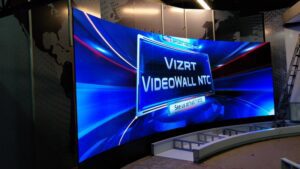
Typical uses follow the shapes in this guide: a curved wall in a retail atrium, a column wrapped in a continuous display, a concave wall in a lobby, and a wave-shaped screen as a centrepiece. In each case the same questions apply — which module family, which pitch, and how the structure holds the curve — and the answers come from the drawing and the viewing distance.

What radius can a flexible LED screen bend to?
There is no single radius number for a flexible LED screen. The bend a display can hold depends on the module family and on the drawing of the curve — its radius, its arc length, and whether it is concave or convex. A small, tight curve and a long, gentle sweep are different engineering problems, and they may call for different module families.
As a rule, the smaller fine-pitch families suit tighter curves and closer viewing, while the larger 400×300 mm family suits gentler curves and larger surfaces. But the rule is only a starting point. Every curve is confirmed against the drawing before production: the radius, the way the modules tile across the arc, and the structure behind them are checked together, so the finished wall holds its shape and the image stays seamless.
Concave and convex curves behave differently. A concave wall wraps the viewer, so the viewing distance is measured from the centre of the curve; a convex surface, such as a column, is seen from outside, so the nearest viewing point is the closest approach to the surface. Both are built from the same families, but the tiling, the structure and the viewing-distance calculation are not the same — which is why the drawing matters more than any single number.
When you ask for a quotation, send the drawing of the surface — the radius and the dimensions of the wall, column or shape — rather than asking for a radius from a table. If the curve can be built with the standard families, the answer is quick. If it is unusually tight or unusually large, the drawing shows what needs to change: a different family, a different module orientation, or a different structure.

Which module family fits your project?
IFlexPro comes in three module families. The choice is driven by viewing distance and by the shape of the surface. The finer pitches (1.25, 1.5625 and 1.875 mm) are for close viewing; the coarser pitches (2.5 and 3.125 mm) are for larger surfaces viewed from further away.
| Module family | Module size | Weight | Pixel pitch |
|---|---|---|---|
| Fine-pitch compact | 288 × 144 mm | 0.4 kg | 1.25 / 1.5625 / 1.875 mm |
| Fine-pitch wide | 300 × 168.75 mm | 0.5 kg | 0.93/1.25 / 1.5625 / 1.875 mm |
| Large-format, single or double face | 400 × 300 mm | 1.15–1.25 kg | 1.25/1.5/1.9/2.5 / 3.125 mm |
Brightness for the fine-pitch families is 800–1,200 nits. All three families share the same core specification: 160° viewing angle, 5000:1 contrast, 16-bit grayscale, 1,920–3,840 Hz refresh, 2,600–9,500 K adjustable color temperature, >99% DCI-P3 color gamut at company level, IP30 indoor rating, and 100,000 hours of LED life at 50% brightness. All mount magnetically, splice seamlessly, and allow front or rear maintenance. Certifications are ETL, TUV-CE, FCC, CB, EAC and RoHS, and the warranty is typically 2–3 years, extendable.
Viewing distance is the deciding factor for pitch. The nearest person to the screen sets the requirement: if viewers can stand close to the wall, the pitch must be fine enough that the image stays smooth at that distance. If the nearest viewing position is several metres away, a coarser pitch gives the same apparent smoothness with fewer modules. State the nearest viewing position in the brief, and the choice between the 1.25–1.875 mm families and the 2.5–3.125 mm family follows from it.
If you are choosing between the two fine-pitch families, the difference is the module format: the 288×144 mm and 300×168.75 mm modules tile differently across a curve, and the right one depends on the dimensions of the surface and the radius. The large-format family, at 400×300×7.6 mm and 1.15–1.25 kg per module, covers a larger area per module and is available as a single-face or double-face module. The double-face option puts a display on both sides of the same surface, which suits freestanding shapes and totems where the screen is seen from two directions.
When the shape is unusual — a tight radius, a double curve, or a surface that changes direction — say so in the brief. The families above cover the standard range, and the drawing shows whether the shape needs a different module orientation or a different structure. A short note on the viewing distance and the ambient light of the room is enough for the first quotation; the full drawing follows once the shape is confirmed as feasible.

How to specify a custom curved LED display
Five decisions settle a custom curved display. Work through them in order, and the quotation that follows is a specification rather than a guess.
- Share the drawings and the radius. Send the drawing of the wall, column or shape, with the radius, the arc length and the overall dimensions, and confirm whether the curve is concave or convex. Feasibility, module family and structure are all confirmed against this drawing before production.
- Set the viewing distance, then the pitch. The closest viewing distance decides the pixel pitch: closer viewing needs a finer pitch, so the image stays smooth at short range. The available range is 1.25 to 3.125 mm across the three families. State the nearest viewing position in the brief, and the pitch follows from it.
- Plan the structure. The structure holds the curve, and its accuracy decides how well the modules sit and how seamless the image looks. Agree who supplies the structure and how the modules fix to it — magnetic mounting is the standard for these modules — and confirm the finished shape against the drawing before the modules are ordered.
- Plan maintenance access. Flexible modules allow front or rear maintenance. Decide which one the site allows before the structure is built: front maintenance needs access to the face of the wall, while rear maintenance needs a service space behind it. The choice is difficult to change once the structure is in place.
- Plan power and control. Confirm the power supply and the control system for the finished wall, and confirm what the site provides for both. The display’s size, pitch and brightness decide the requirement, so this step follows the first four rather than preceding them.

FAQ
Can a flexible LED screen wrap a full column?
Yes. Columns are one of the main uses of flexible modules: the modules tile around the column and splice seamlessly, so the column reads as one continuous display. Send the column diameter and height with the drawing, and feasibility is confirmed before production.
What pixel pitch do I need?
It depends on the closest viewing distance. The range across the three IFlexPro families is 1.25 to 3.125 mm: finer pitches (1.25, 1.5625 and 1.875 mm) for close viewing, and coarser pitches (2.5 and 3.125 mm) for larger surfaces and longer viewing distances.
How bright is it?
The fine-pitch families are rated at 800–1,200 nits. Brightness is one of the reasons the pitch decision and the viewing-distance decision are made together: a closer screen needs a finer pitch, and the brightness must suit the ambient light of the room.
Can it be used outdoors?
No. The modules are rated IP30, which is an indoor rating. They are designed for indoor installations — the curved walls, columns and shaped screens this guide covers.
How long will it last, and what is the warranty?
LED life is 100,000 hours at 50% brightness. The warranty is typically 2–3 years and can be extended. Both figures assume the indoor use the modules are rated for.
What certifications does it carry?
ETL, TUV-CE, FCC, CB, EAC and RoHS. If your project needs a specific certificate for handover, confirm it in the brief so it is covered in the quotation.
To start a project, send your drawings to info@durway.com. Include the radius, the overall dimensions and the nearest viewing position, and the first answer will cover feasibility, family and pitch. We will confirm whether the curve can be built, which module family fits it, and the pixel pitch for your viewing distance. We turn clients’ concepts into reality.


