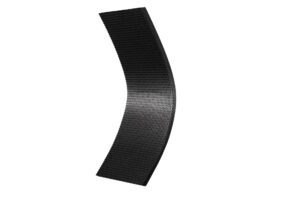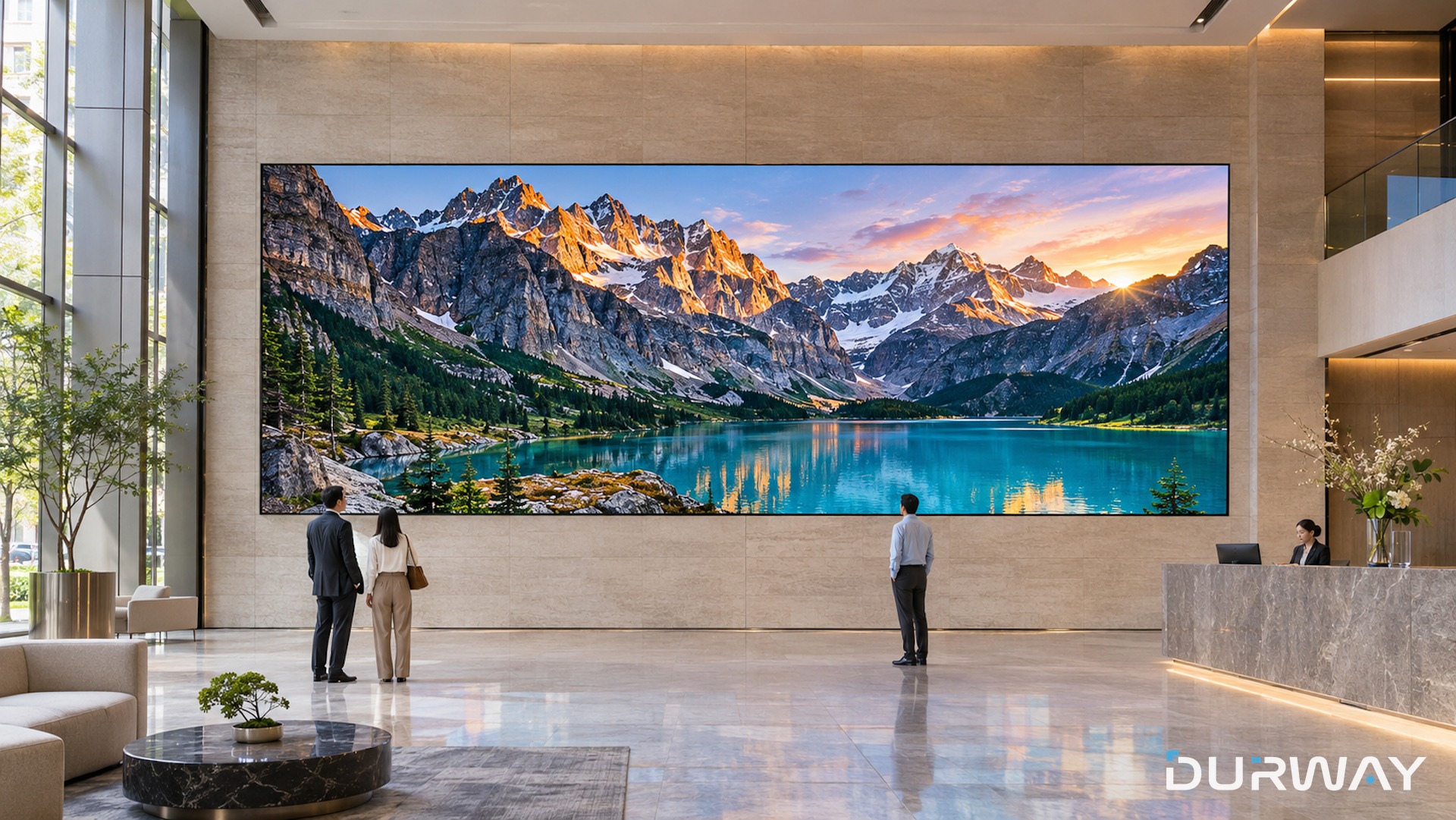
In short: SMD builds each pixel from a pre-packaged LED lamp soldered onto a circuit board; COB bonds the LED chips directly onto the board and seals them under one continuous matt resin surface. At fine pixel pitches — the 0.78–1.56 mm range used for close-viewing indoor walls — that construction difference decides how the wall looks, how well it survives daily contact, and how it is serviced. Durway’s VistaPro range is a COB/MIP fine-pitch platform built around 600 × 337.5 mm die-cast cabinets with full front maintenance, and it exists precisely for the rooms where those differences matter most.

What is the real difference between COB and SMD?
The two names describe how the light-emitting part of the screen is built, and everything else follows from that.
In an SMD (surface-mount device) display, each pixel is a finished lamp: red, green and blue diodes sealed inside a small plastic package, which is then soldered onto the PCB. The wall surface is therefore a field of individual lamp housings, with the board and the gaps between lamps exposed to the room. SMD is the established, widely available construction, and at larger pixel pitches it works well.
In a COB (chip-on-board) display, the LED chips are bonded directly onto the substrate and covered by a single continuous layer of resin. There are no individual lamp housings. The finished surface is flat, sealed and — on Durway’s VistaPro range — matt, which is why a COB LED video wall at 0.78 mm pixel pitch can hold a smooth, even image at distances where an SMD wall of the same pitch starts to look grainy and fragile.
A third route, MIP (micro LED in package), packages the chips at micro scale before mounting; VistaPro is a COB/MIP platform, and the practical points in this article — sealed surface, fine pitch, front service — apply across it.
Why does the gap widen as the pitch gets finer?
Pixel pitch shrinks the hardware. At 2.5 mm or 3 mm, an SMD lamp is large enough to be robust. At 0.78–1.56 mm, the lamps and their solder joints become very small, and three problems appear:
- Fragility. Exposed micro-lamps can be knocked off or damaged by contact, cleaning or installation handling — a real risk on walls people walk up to and touch.
- Surface quality. The gaps between lamp housings scatter ambient light and lighten the black level, so contrast and colour depth suffer exactly in the bright, close-viewing rooms fine-pitch walls are bought for.
- Consistency. Thousands of individual packages must match in brightness and colour; variation shows as patchiness on a large flat image.
COB answers all three structurally: the chips sit under one sealed resin layer, so there is nothing to knock off, the matt surface absorbs ambient light instead of scattering it, and the emitting surface is uniform by construction. This is why the fine-pitch indoor segment — control rooms, boardrooms, flagship retail, experience centres — has moved toward COB.
COB vs SMD at a glance
| Factor | COB | SMD |
|---|---|---|
| Pixel construction | Chips bonded directly to the board, sealed under one resin layer | Pre-packaged lamps soldered to the board |
| Surface | Flat, sealed, matt; can be wiped clean | Individual lamp housings; gaps exposed |
| Contact and impact | Surface is protected; suited to walls people approach and touch | Exposed lamps can be damaged by contact |
| Practical fine-pitch range | Built for sub-1 mm to ~1.56 mm indoor work | Comfortable at larger pitches; increasingly fragile below ~1.5 mm |
| Black level and contrast | Deep blacks from the continuous matt surface | Lamp housings and gaps lighten the black level |
| Moisture and dust | Sealed surface resists dust and damp | Open structure needs more care |
| Repair | Module-level service from the front | Individual lamps can be reworked, but failures are more frequent at fine pitch |
| Typical fit | Close-viewing indoor walls: control rooms, boardrooms, lobbies, flagship retail | Larger-pitch indoor and outdoor walls, rental fleets |

What do the numbers look like on a COB wall?
Using Durway’s VistaPro range as the reference point, a COB LED video wall at 0.78 mm pixel pitch — the finest of the four standard pitches (0.78 / 0.93 / 1.25 / 1.56 mm) — is built from cabinets of 600 × 337.5 mm in die-cast aluminium, 5.5 kg each, each cabinet carrying a native 768 × 432 pixels at 0.78 mm. Because every cabinet is exactly 16:9, walls scale cleanly to standard video formats.
Across the range, the published figures are: brightness of 400–1,000 nits, contrast of 5,000–20,000:1, colour depth of 13–16 bits, a refresh rate of at least 3,840 Hz, a 160° viewing angle horizontally and vertically, and an adjustable colour temperature of 2,600–9,500 K. Colour performance is specified at company level as greater than 99% of the DCI-P3 gamut. Maximum power consumption is 300 W/m², with an average of 215 W/m² — figures a facilities team can plan around. The range carries TUV-CE, ETL, FCC and CCC certification.
None of these figures is exclusive to COB in isolation — a good SMD wall can post similar headline numbers. The COB advantage is that the surface delivering them is sealed, matt and uniform, so the wall still looks like the specification after a year of daily use in a public room.
How do maintenance and repair compare?
Fine-pitch walls are serviced from the front or not at all: they are usually mounted flat against a finished wall, recessed into joinery, or standing in a room with no service corridor behind them. VistaPro is a full front-access system — cabinets and modules are removed and replaced from the viewing side, so a fault does not mean dismantling the wall or closing the room for structural work.
With SMD at fine pitch, the typical failure is a single lamp or a small cluster, and the repair is a bench-level rework of individual components. It is repairable, but it is slower, more delicate, and the failures happen more often because the lamps are exposed in the first place. On a COB wall, the sealed surface prevents most contact damage outright, and service is a module swap rather than component surgery. And the COB led modules will be repaired by the machine.
When does SMD still make sense?
COB is not the answer to every project, and a balanced specification should say so:
- Larger pitches. Above roughly 2 mm, SMD lamps are robust, the surface issues fade with viewing distance, and SMD is usually the economical choice.
- Outdoor walls. Exposed outdoor displays are a mature SMD segment with its own protection methods; VistaPro is an indoor range.
- Rental and staging. Fleets that are assembled and struck weekly have their own cabinet ecosystems, largely SMD-based.
- Tight budgets at moderate pitch. If the audience never comes close, paying for sub-1 mm COB buys resolution nobody can see.
The honest dividing line is viewing distance plus contact: if people will stand close, read fine detail, or touch the wall, COB earns its place. If not, SMD may serve the project just as well for less.
What decides the total cost over the wall’s life?
Purchase price is only the first line. Three running factors separate the two constructions over a five-to-ten-year life. Energy: a fine-pitch wall runs for long hours, so average consumption — 215 W/m² on VistaPro — compounds into a real operating figure, and it belongs in the comparison, not just the headline maximum. Failure rate: every avoided failure is a service visit that never happens; a sealed COB surface removes the most common cause of fine-pitch callouts, which is contact damage to exposed emitters. Service time: front-access module replacement is measured in minutes per module with the room back in use the same day, while component-level rework on an SMD lamp field is bench work that can take the affected section out of service for longer. None of this makes COB cheaper in every case — at larger pitches, SMD’s lower purchase price usually wins the whole-life comparison too. It means the comparison should be run on the project’s actual viewing distance, hours and environment, not on the square-metre price alone.
How to choose between COB and SMD, step by step
Step 1 — Fix the closest viewing distance. Measure where the nearest viewer will stand or sit. Inside roughly two metres, specify fine pitch (0.78–1.25 mm), which points to COB. Several metres back, open the comparison to SMD at larger pitch.
Step 2 — Assess contact and environment. Is the wall in a public lobby, a retail floor or a corridor where it will be touched, brushed or cleaned daily? A sealed COB surface is the safer specification. A wall behind glass or out of reach is less exposed.
Step 3 — Decide the maintenance direction before the structure is designed. Confirm front access if there is no rear service space, and state it in the enquiry — it affects cabinet selection, structure design and the spare-parts list.
Step 4 — Check the image requirements, not just the pitch. For camera-facing or colour-critical rooms, confirm refresh rate (≥3,840 Hz on VistaPro), colour depth and gamut coverage, and ask for the full specification sheet rather than a headline pitch number.
COB vs SMD: frequently asked questions
Is a COB wall more expensive than SMD?
Per square metre at the same fine pitch, COB generally costs more to buy. The comparison that matters is whole-life: fewer contact failures, faster front service and a surface that keeps its appearance. At larger pitches the balance reverses and SMD is usually the rational buy — which is why the decision starts with viewing distance, not technology.
Can a COB surface be cleaned?
Yes. The continuous resin surface can be wiped down, unlike an exposed SMD lamp field where cleaning risks damaging lamps. This is one reason COB suits public-facing walls in lobbies and retail.
Which COB pitch should I choose — 0.78, 0.93, 1.25 or 1.56 mm?
Match it to the closest viewer: 0.78 mm for the closest, most detail-critical work such as control rooms; 0.93 and 1.25 mm for boardrooms and corporate walls; 1.56 mm where the audience stays a few metres back. The four pitches share the same 600 × 337.5 mm cabinet, so the wall format does not change with the pitch.
Does COB work with standard control systems?
Yes. Durway supplies NovaStar control as the default; other ecosystems such as Colorlight or Brompton can be fitted to the client’s requirements. The control choice is confirmed at proposal stage, against the project’s existing infrastructure.
Is COB suitable for a 24/7 control room?
That is one of its home environments. VistaPro is specified for stable long-run operation with managed heat dissipation, front service that avoids taking the wall apart, and remote diagnostics — the three things a control room actually depends on.
Durway designs and manufactures fine-pitch COB/MIP video walls for rooms where the display cannot afford to look uneven or sit dark waiting for service. We turn clients’ concepts into reality. For a specification or a project discussion, contact us at info@durway.com.